Proposal (1069) to South
American Classification Committee
Recognize new species of Tinamus/Crypturellus
Morais et al. (2025) have described a new
species of tinamou as Tinamus resonans from the isolated Cerro do
Divisor in Acre, western Amazonian Brazil; although it is clearly in the Crypturellus
clade, the authors followed Bertelli et al. (2025) in using Tinamus for Crypturellus,
based on strict priority:
“The genus Tinamus Hermann, 1783 was recently
redefined by Bertelli et al. (2025), who restored its priority for the clade
historically referred to as Crypturellus Brabourne & Chubb, 1914.
Following their treatment, we here consider all species phylogenetically allied
with Tinamus soui Hermann, 1783 as belonging to Tinamus.”
This issue will be addressed in a separate
proposal. In my opinion, this case
illustrates exactly why the Code has the Prevailing Usage provision. For the purposes of this proposal, the name
SACC would be Crypturellus resonans, pending results of the separate
proposal.
This new tinamou population was first detected
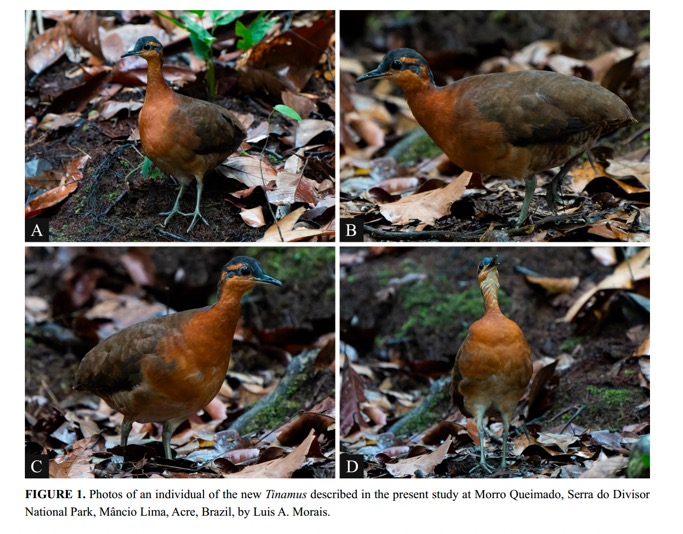
vocally on the Cerro do Divisor by Fernando Godoy in October 2021. The authors first obtained photos (see below)
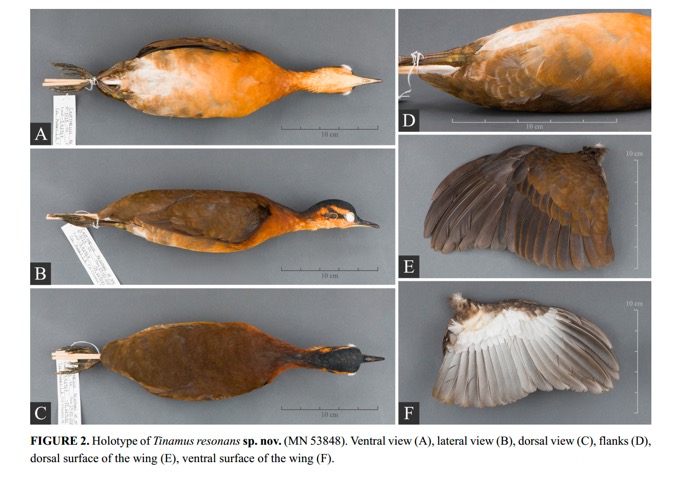
and then obtained 3 specimens, all females, deposited at the Museu Nacional,
Rio de Janeiro. The population as far as
is known is restricted to the slopes of the Cerro:
“The species was observed exclusively on the steep
forest floor within a narrow transitional zone between 310 and 435 m a.s.l.,
representing a gradient between submontane and stunted forest. This habitat is
characterized by an exceptionally dense and widespread mat of fine roots and
leaf litter, forming a continuous network over nutrient poor, quartzitic
sandstone soil (Mendonça et al. 2020, 2023), through which the tinamou moves
and forages. At all surveyed sites, the species was found in sympatry with Thamnophilus
divisorius, which in Brazil was previously known only from its type
locality, Morro Queimado.”
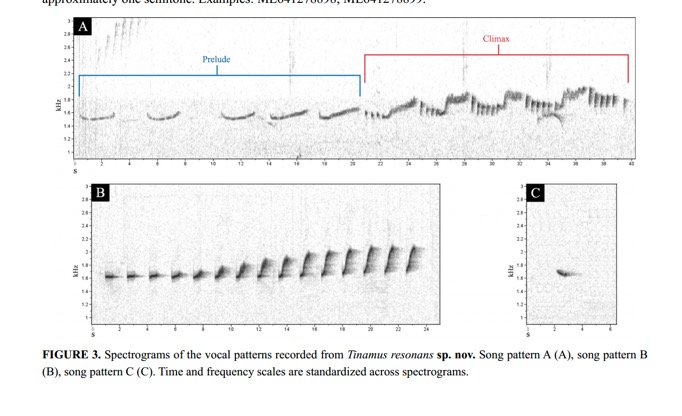
Sonograms were published in the paper,
but the recordings are apparently not available online.
Tissue samples were collected and stored
at Museu de História Natural do Ceará and INPA, but have not been analyzed.
The authors compared the plumage and
voices to those of other Crypturellus but did not quantify those
comparisons but simply asserted that they were diagnostic and let the photos
and sonograms speak for themselves:
“Diagnosis: This species differs
from all other Tinamidae by presenting, at least in females (the three
individuals whose sex could be determined were female), a distinctive dark
slate-colored crown, which extends into a prominent stripe down the hindneck
and into the post-ocular region, forming a conspicuous facial mask (Fig. 1 and
2). The ferruginous coloration of the breast places it near the T.
variegatus/brevirostris group, from which it is readily distinguished by
its uniform brownish-gray dorsum lacking any barring, a condition otherwise
shared only with T. soui. It can be further separated from T. soui
by its ferruginous breast, neck, and cheeks and the presence of white on the
lower belly. Its vocalization is unique and therefore diagnostic among the
vocalizations attributed to other Tinamidae. As described below, it is
distinguished by its overall structure and note modulation.”
Discussion and recommendation: This is a remarkable new discovery! Congratulations to the authors. The bird is strikingly distinctive in plumage
and as far as I can tell, voice. I
recommend a YES.
English name: Morais et al. proposed “Slaty-masked Tinamou” to highlight its most
distinctive phenotypic feature (see photos).
I see no reason not to go with this, but if anyone objects, speak out
and be prepared to propose a substantially “better” name. If it had been me, I would have gone with
something like “Divisor Tinamou” to emphasize the importance of preserving
habitat on that mountain range, and if anyone has the energy to do a proposal
on this, now would be the time.
References:
MORAIS, L. A., M. A. CROZARIOL, F. I. GODOY, R. A. A. PLÁCIDO, AND M. A.
RAPOSO. 2025. A new species of Tinamus (Aves:
Tinamiformes) from the western Amazon, Brazil.
Zootaxa 5725: 279–291.
Van Remsen,
December 2025
Note from Tom Schulenberg: audio recordings of resonans at
Vote tracking chart:
https://www.museum.lsu.edu/~Remsen/SACCPropChart1044+.htm
Comments from
Robbins: “YES. Wow, amazing discovery of
an obvious very distinct tinamou. An emphatic Yes for acceptance.”
Comments from
Lane: YES. This is a shockingly obvious
new species from a group that has relatively little morphological distinction
among its members! I am a bit surprised that the authors did not make an effort
to review the online documentation of tinamous from the Divisora,
or they would have been able to include this recording from Peru by Tom
Schulenberg in 2005: https://macaulaylibrary.org/asset/235615
but that's neither here nor there in accepting the species to the SACC list.”
Comments from
Bret Whitney (who has Remsen vote): “YES to this highly distinctive new species. Nomenclatural
issues surrounding the genus aside, the description is excellent,
well-documented and nicely presented. If anyone wants to hear some of the
distinctive vocalizations and view some video, including the locality of
discovery and the lead author’s comments, go to YouTube and search “dodó brasileiro”.”
Comments from Zimmer: “YES.
Plumage and voice are both unique within the family, so this is an easy
one as far as I’m concerned. Several
species within this genus are sexually dimorphic in plumage, so I am curious as
to whether this one is. All 3 specimens
are females, but I don’t see any indication of field observations of any
individuals that differed in appearance from the type series. Congratulations to all involved on a
remarkable find!”
Comments from Thomas
Valqui (guest voter): “YES. I would say it seems safe to say it is a
new species. The video is particularly convincing although it really is one
short song only. The size seems also to be quite different from soui, as
mentioned previously.”
“I was hoping
there would be some DNA to look at sister taxa before deciding. I heard it was
already done, but apparently not made public. They also mention they have
regular soui from nearby, although no pictures or recordings. So there
seems to be a lot of evidence to make a very strong case, but not much material
to validate the evidence.
“Anyway, not
fully convinced, but I would vote for it being a new species.”
Comments
from Claramunt: “YES. Amazing discovery. Further studies will elucidate its
phylogenetic position but the evidence for its species status seems solid,
considering its vocalizations and in particular its plumage.”
Comments from
Bonaccorso: “YES. A very interesting
finding. The unique plumage, even though the material includes only females,
makes a strong case for a new taxon. It would have been helpful to see more
comparisons with other species, especially genetic and vocal data, but the
description appears solid. The possible restricted distribution of this taxon
to Serra do Divisor is notable. The fact that Thamnophilus divisorius
is also endemic to the same region suggests that interesting evolutionary
processes may be occurring in that mountain range.”
Comments
from Naka: “YES. Amazing discovery.”
Comments from
Areta: “"YES, a very nice bird
occurring on the two countries that harbour this
massif. I look forward to the phylogenetic data and to more comparative work on
the vocalizations, to further contextualize the differences of this
range-restricted new tinamou."
Comments from
Stiles: “YES - based on distinctive
features of genetics, phenotype, habitat and voice (!) - Very distinctive!”