Proposal (1073) to South
American Classification Committee
Use “Whitestart” as the English name for species of Myioborus
Consistent
with the use of “Amazon” for Amazona and “Flatbill” for Tolmomyias,
this recommendation is an attempt to bring about greater agreement between
global bird lists and presents an opportunity to have a unique name (“Whitestart”) apply to a single well-defined genus (Myioborus).
This name has been popular with field guide authors for more than two decades
and claims that “Slate-throated Redstart” is the clear name choice based on
prevailing usage are no longer correct. In fact, it seems that momentum favors Whitestart, with four major global checklists, multiple
regional field guide authors, and even opinions of past “no” voters shifting
towards Whitestart in recent years. The publication
of AviList v2025 (AviList Core Team 2025) presents an opportunity for consensus
on English names where possible—and the names of Myioborus would be an
easy place to find agreement if NACC and SACC (along with eBird/Clements) agree
to align around Whitestart.
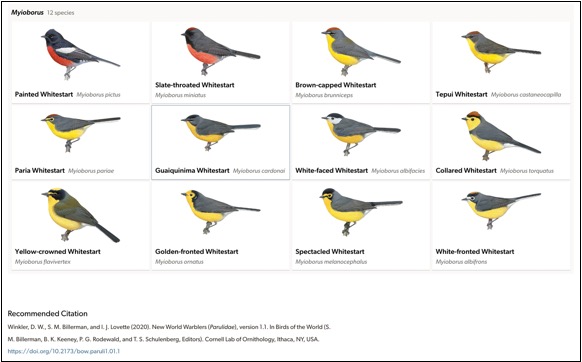
Fig.
1:
Species within the genus Myioborus, using English name preferences from
AviList v2025 (within eBird and Birds of the World, users can select
their preferred English names, including eBird/Clements names which would use
“Redstart” here in alignment with AOS-NACC and SACC). https://birdsoftheworld.org/bow/species/paruli1/cur/species#genusMyioborus
Previous
NACC and SACC proposals
Proposals
on this issue have been raised four times before: twice for AOS-SACC and twice
for AOS-NACC. Perhaps no other English name issue has been voted on so
frequently without being changed, indicating strong preferences by many
regarding the use of Whitestart.
The
previous proposals are as follows:
· October 2003, SACC 63: https://www.museum.lsu.edu/~Remsen/SACCprop63.htm
· 2004, NACC (Banks et
al. 2004)
· March 2005, SACC 171: https://www.museum.lsu.edu/~Remsen/SACCprop171.htm
· March 2016, NACC
2016-A: https://americanornithology.org/wp-content/uploads/2020/02/2016-A.pdf and comments: https://americanornithology.org/about/committees/nacc/current-prior-proposals/2016-proposals/comments-2016-a/#2016-A-2
SACC
63: failed 3/6, but Jaramillo and (in Proposal 173) and Schulenberg (pers.
comm.) both changed their minds on this issue.
SACC
171: failed 4/5; Robbins did not vote but had voted for Whitestart
in SACC 63.
NACC
2016: 2 voted for Whitestart, 8 voted against (one
indicating openness to a proposal that reframed the issue)
Most
previous proposals and commentors have acknowledged the problems with the name
Redstart, including:
1) The tails of Myioborus show
flashes of white, not red;
2) 10/12 species in Myioborus
are strikingly yellow and gray and only one (Painted Redstart), sometimes two
(northern populations of Slate-throated Redstart), show red plumage (Fig 1);
3) Although all Myioborus
are closely related and congeneric, they are no longer considered closely
related to the other redstart in Parulidae (Setophaga ruticilla) and
obviously are much more distantly related to Old World redstarts in
Muscicapidae (Fig. 2)
The
first SACC proposal acknowledged:
If we were "starting from scratch, I'd vote for "Whitestart." It is more accurate, and it nicely
emphasizes that Setophaga and Myioborus are not sister genera.
But
that proposal recommended a “no” vote on the change, citing a statement by
Ridgely and Tudor (1989) that “we feel that the name “Redstart” is simply too
well entrenched to be changed at this late date.” Those voting for Whitestart noted:
Stiles: Whitestarts - definitely a better name, the question is
whether it is worth changing. This name has been around since a Nuttall
monograph on social behavior of Andean birds by Moynihan (1980? [1979]), if not
before. Redstart is definitely inappropriate for most Myioborus in a
literal sense (not only no red in the tail, but no red anywhere), but finds its
justification in the superficial similarity with Setophaga and in the
fact that M. pictus, the only one to reach the US, does have a red
breast. Redstart is the classic name, but a number of important new works do
incorporate Whitestart.
Nores: Si. Este parece un problema más sentimental que ornitológico. Redstart es evidentemente
inapropiado para especies
que no tienen color rojo y por
eso es mejor "Whitestart". Sin embargo, hay opiniones
como la de Stotz que evidentemente
están más relacionado con la costumbre de
usar un nombre y con no ofender
a las especies."
Furthermore,
two of the voters (Zimmer and Jaramillo) mentioned that Painted Redstart would
be hard to change, presumably because it is the one truly red Myioborus
and because it is the most familiar one to US/Canadian birders.
The
second proposal to SACC did not provide new arguments and seemed vituperative
in tone. Notable comments were:
Jaramillo: YES - I still do not like the sound of Painted Whitestart, but my mind has changed on this subject. Yes, I
do want name stability, but that is balanced by certain name changes here and
there when the name is truly misleading. Calling something a Little Nightjar is
fine even though it may not be the smallest Caprimulgid in the world. There is
the other extreme where the name really is dead wrong or misleading, the more I
sit back and think about this one, the more comfortable I am in putting it in
that category. In effect this is the equivalent of calling Bubo scandiaca
the Sooty Owl -- it is just incorrect. There is no red on the tail, so Redstart
is not appropriate. Setophaga is the American Redstart and that is
appropriate, the name Redstart for Myioborus is misleading and
confusing. One of the reasons we want name stability is to minimize confusion;
I would argue that a grossly incorrect English name provides confusion. So, if
we are in the mindset of minimizing confusion, maybe the name change in this
case wins over the stability issue, it does for me.
Pacheco: YES. Por razões óbvias, não é confortável
para mim opinar acerca da "propriedade"
e conveniência dos nomes em Inglês. Logo, o meu voto aqui tem
caráter meramente opinioso. Após ler o extenso arrazoado, alinho-me com a opinião do Álvaro."
Also
notably, one voter (Robbins) preferred Whitestart but
voted no, apparently out of principle (since he felt the issue had already been
adjudicated) and in part because of the tone of the proposal.
The
NACC proposal in 2016 (NACC 2016-A-02) raised these points:
· “Whitestart”
means “white tail” and is more appropriate than Redstart for birds with white
in the tail
· “Redstart” implies a
taxonomic connection to Setophaga ruticilla (and potentially to Old
World Redstarts in the genus Phoenicurus).
· Whitestart is “accepted by
multiple authorities”
That
proposal concluded with this recommendation:
This change has three advantages: (1) it eliminates misleading names
from North American birds, (2) it prevents widespread confusion on naming
conventions, and (3) it increases knowledge of correct species taxonomy and
emphasizes its importance in bird identification. If we keep the names as they
are, we would thus continue to misappropriate and
perpetuate the ignorance of the general public. Likewise, we already have the
English name “Whitestart” for the genus Myioborus,
already accepted by multiple authorities, of which the structure of the English
name would be familiar, pronounceable, and far more accurate.
The
2016 previous NACC voters opted for Redstart 8-2, with one Yes voter stating:
“YES. Although I am generally for stability the English names, the use
of “Redstart” for species in Myioborus by the NACC is no longer stable.
Rogue field guide authors and alternative checklists have embraced the far
better name “Whitestart,” such that the NACC and its
adherents are nearly alone in using “Redstart.” It is time to face the
inevitable and adopt the better name. Not doing so makes us look like
anachronistic old cranks. Most sources not affiliated with the NACC or SACC use
“Whitestart.” Google Myioborus for instance.
“A few of you have remarked that passing this proposal would leave the
problem of “American Redstart.” I think very few ornithologists/birders have
any problem with the name “American Redstart.” We are “stuck” with all sorts of
new-world species sharing a the [sic] same group name as a similar
species and acting but unrelated Old World species (Robin, Flycatcher, Bunting,
Oriole, Warbler etc.), and those names are with us for the long haul. The red
in the American Redstart is not that different in tone from the red in many Old
World Redstarts. At least one Phoenicurus has no red at all. “Orangestart” would have been a better name, but there is no
more problem calling Setophaga ruticilla American Redstart than there is
calling Turdus migratorius American Robin.
“The problem is with species in Myioborus. These are not related
at all to Setophaga (or Phoenicurus). Because Myioborus
and Setophaga ruticilla share a common faunal region (the New World) and
family, it is confusing having unrelated species sharing a distinct name like
“Redstart” (unlike the more generalized names warbler, sparrow, flycatcher or
bunting). The twelve or so species of Myioborus are monophyletic, share
a distinct foraging behavior, and a distinct plumage character related to that
foraging (white in the tail, which is used to flush (=start) insect prey. As
such, the name “Whitestart” could not be more
fitting, and it clears up a confusion regarding relationships. Only two of the
12 species (Painted and Slate-colored) have more than a little red. A few
others have brownish red in the caps. Most species have no red at all.”
Historical
usage of Redstart and modern phylogeny
The
species in Myioborus were once placed in Setophaga, along with
American Redstart Setophaga ruticilla, which created an assemblage that
was presumed to have been monophyletic.
The
first SACC proposal (63) summarized some of the history behind the use of
“Redstart”:
The warblers in the genus Myioborus were known
as "Redstarts" for all of their history until last decade or so. This
presumably derives first from the very superficial resemblance of North
American Setophaga ruticilla to the "real" Redstarts of Europe
in the genus Phoenicurus, which share orange-red coloration in the
rectrices and tail movements that accentuate it. Second, the Painted Redstart
was given that English name when incorrectly placed in Setophaga, even
though it had white where the "real" Setophaga had orange, and
the species of Myioborus, by implication considered the sister genus to Setophaga by
Ridgway (1902), were also called "Redstarts." Widespread M.
miniatus was described in Setophaga, so it was only logical to use
"Redstart" for it and relatives. Thus, Myioborus miniatus
and Middle American M. torquatus have been called
"Redstarts" for over a century. Coues (1872) used
"Redstart" for both M. pictus and M. miniatus.
It
was only in 1976, with the publication of the 33rd supplement to the
5th edition of the AOU Check-List (AOU 1976), that the genus Myioborus
Baird, 1865 (with type species Setophaga verticalis Swainson) was
resurrected, and at that time, the name “Redstart” was carried over for all
included species without question. More recently, Setophaga ruticilla
was found to be embedded within the large genus Dendroica, resulting in
the genus Dendroica being subsumed into Setophaga. The usage of
Redstart for Myioborus appears to be a legacy of when Myioborus
and Setophaga ruticilla were believed to be closely related, which we
now know is not the case. Modern phylogenetic information (Fig. 2) shows that
the Myioborus assemblage is closer to Cardellina (e.g., Wilson’s
Warbler) and Basileuterus (e.g., Golden-crowned Warbler) than to
American Redstart Setophaga ruticilla.
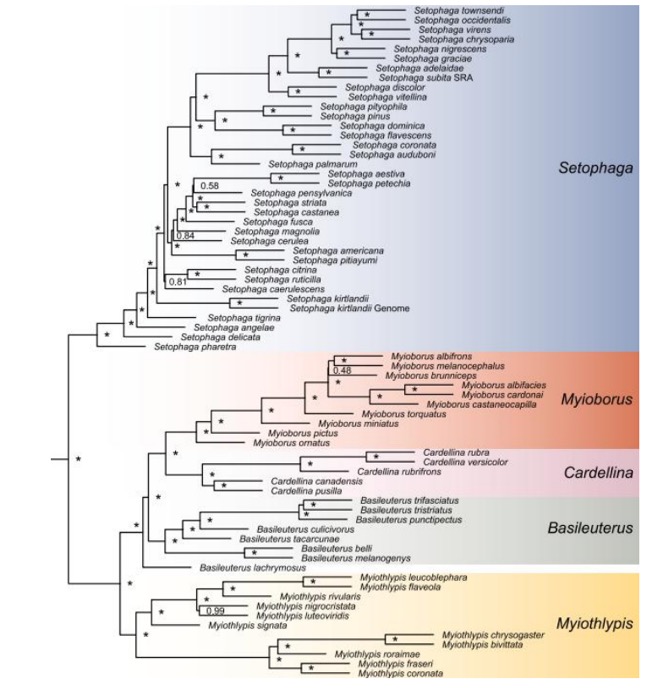
Figure 2. Relationships of selected species and genera of Parulidae,
showing the lack of a close relationship between Myioborus and Setophaga
ruticilla (from Zhao et al. 2025).
When
is usage prevailing?
Voters
on past proposals in 2002 and 2004, considered that “Redstart” was
well-entrenched for the genus. But is that still the case?
Googling
Myioborus lands on a Wikipedia page that is entitled “Whitestarts”. The other Wikipedia pages mostly use Whitestart but do use Painted Redstart for M. pictus.
eBird and Cornell Lab hits still defer to Redstart, in observance of the NACC
and SACC name, but almost all other sources use Whitestart.
Even a 2009 article in the Wilson Journal of Ornithology used “Whitestart” (Mumme 2009). Neither name is now clearly “prevailing”.
Major
global checklists increasingly use Whitestart for Myioborus.
Below is a summary of the use of Redstart and Whitestart
across major regional or global checklists. Note that these are not entirely
independent: NACC and SACC were both formerly committees of the AOU/AOS.
Clements has explicitly followed NACC/SACC names, to the extent feasible, while
AviList has explicitly followed IOC names.
· The AOU/AOS
Checklist has consistently used “Redstart” for all Myioborus
from 1886 to present
· The SACC Checklist
(https://www.museum.lsu.edu/~Remsen/SACCBaseline.htm) has consistently used
“Redstart” for all Myioborus from its inception to present
· The Clements
Checklist
(https://www.birds.cornell.edu/clementschecklist/introduction/updateindex/) has
consistently used “Redstart” for all Myioborus from its first
edition to present (although it has explicitly tried to align with English
names of AOS-NACC and SACC). However, the undersigned authors of the current
eBird/Clements Checklist (Clements et al. 2025) hereby recommend the use of “Whitestart” for all Myioborus.
· The Howard & Moore
Checklist (4th edition; Dickinson and Christidis 2014) uses “Whitestart” for all Myioborus, but used
“Redstart” in the 1st, 2nd and 3rd editions.
· The IOC Checklist (Gill
et al. 2025) has used “Whitestart” for all Myioborus
since its inception to the present day (v15.1)
· AviList v2025 uses “Whitestart” for all Myioborus because almost
all English names are aligned with IOC 15.1
· The HBW/BirdLife
International Checklist (del Hoyo and Collar 2016) uses “Whitestart”
for all Myioborus but used “Redstart” through BirdLife’s
version 08 (Oct 2015).
Despite
the lack of independence between the various lists, the momentum has been
towards increased usage of Whitestart for Myioborus.
Both HBW/BirdLife and Howard & Moore 4th edition have changed
from Redstart to Whitestart in recent decades, and
the eBird/Clements team also recommends this change. NACC and SACC are the
primary players that continue to advocate for Redstart for Myioborus.
Field
guides similarly have used both names. Some authors committed to one or the
other, while others expressed the alternate name in parentheses. Either way, an
incomplete selection of guides shows inconsistency on the names chosen, and it
is clear that both names are in use.
|
Name for Myioborus
miniatus |
Field Guide |
comments |
|
Slate-throated Redstart
(Whitestart) |
Colombia – Hilty and
Brown (1986) |
|
|
Slate-throated Whitestart |
High Andes – Fjeldså and Krabbe (1990) |
|
|
Slate-throated Redstart |
Mexico – Howell and Webb
(1995) |
|
|
Slate-throated Whitestart |
Ecuador – Ridgely and
Greenfield (2001) |
“they were formerly
usually called “Redstarts” |
|
Slate-throated Whitestart |
Venezuela – Hilty (2003),
2nd ed |
“called Redstarts by most
previous authors” |
|
Slate-throated Redstart |
Northern South America –
Restall et al. (2006) |
follows SACC |
|
Slate-throated Redstart |
Peru – Schulenberg et al.
(2007) |
Myioborus Redstarts have prominent white outer tail
rectrices (source of alternate name “Whitestarts”) |
|
Slate-throated (Redstart
or) Whitestart |
Brazil - von Perlo (2009) |
|
|
Slate-throated Redstart |
Panama – Angehr and Dean
(2010) |
|
|
Slate-throated Redstart |
Central America – Vallely
and Dyer (2018) |
follows NACC |
|
Slate-throated Redstart |
Ecuador – Freile and
Restall (2018) |
follows SACC |
|
Bolivia: Slate-throated Redstart
(Whitestart) |
Bolivia – Herzog et al.
(2019) |
|
|
Brown-capped Whitestart (for M. brunniceps) |
Argentina – Pearman and
Areta (2020) |
no mention of “Redstart”
as alternate name |
|
Slate-throated Whitestart (Redstart) |
Costa Rica – Dyer and
Howell (2023) |
|
Note
that SACC proposal 171 lists an
additional 14 works that also used Whitestart,
including several CD sound compilations.
Regardless,
Redstart is certainly no longer the overwhelmingly used name for Myioborus,
and it looks much more like NACC and SACC have been swimming against the tide,
especially given the number of field guide authors who generally align with
names endorsed by NACC and SACC, except in the case of this genus.
Evolving
opinions
In
addition to global lists and field guides, the opinions of a number of
individuals have been evolving on this question. For example, MJI has long felt
attached to the name Redstart for this genus, and especially for Painted
Redstart (as mentioned by Zimmer and Jaramillo in their 2002 SACC votes).
(However, we feel that sentimental attachment to the name of one North American
species, for a mainly tropical American genus, is not the best approach in
deciding on names for this 12-species genus.) But with more travel and broader
experience of the genus Myioborus, the name Redstart has felt less and
less appropriate to MJI for this assemblage of yellow parulids with white tail
flashes, and it is apparent that many birders in Central and South America
simply know these birds as Whitestarts. Whitestart now clearly feels like a better, easier handle
for this genus.
Others
have similarly changed their opinions:
· Robert Ridgely
recommended sticking with Redstart in Ridgely & Tudor (1989), but then used
Whitestart in Birds of Ecuador (Ridgely and
Greenfield 2002).
· Steve Howell used
Redstart in Birds of Mexico (Howell and Webb 1995), but Whitestart in Finding Birds in Mexico (Howell 1999)
and subsequent works such as Birds of Costa Rica (Dyer and Howell 2020).
· Tom Schulenberg voted
for Redstart in two prior SACC votes, but now strongly prefers Whitestart (pers. comm. to Iliff on 2 Apr 2026).
· Alvaro Jaramillo voted
for Redstart in his initial SACC vote (2002), but for Whitestart
in his second vote (2004).
· Steve Hilty used
Redstart in Birds of Colombia (1986), but Whitestart
in Birds of Venezuela (2003) and Birds of Colombia (2021, though
followed by Redstart in parentheses)
· Gary Stiles (1989) used
Redstart in Birds of Costa Rica, but clearly expressed preference for Whitestart in his 2002 and 2004 SACC votes.
The
case to retain “Redstart” for Myioborus
With
four previous proposals, there has been a lot of ink spent in defense of
retaining “Redstart” for Myioborus, despite the acknowledgment that it
is not an appropriate name and is misleading about relationships.
Across
those three proposals, the “no” votes have consistently expressed three
philosophies:
1.
If
we tried to “fix” cases where incorrect relationships are implied, then not
only would American Redstart also need to change, so too would many tanagers,
warblers, flycatchers, robins, etc.
2.
Stability
in English names is important and so we should not change when we can avoid it
3.
Many
bird names are imperfect or even inappropriate; we should not be in the
business of “common name improvement”
Point
1 above is not the point of this proposal. We are not recommending changing the
name American Redstart or any other species. This proposal is limited to Myioborus.
Also,
while we do believe that Whitestart is a better name
for many reasons, the main reason for this proposal is in the name of
consistency and long-term stability of names. The widespread adoption of Whitestart, which is so much more descriptive, has
destabilized the English names for these birds. Also, modern genetic
information has clarified relationships and showed clearly that a close
relationship between Setophaga ruticilla and Myioborus, as
believed at the time of the 5th edition of the AOU Check-List, does
not exist.
Why
change now?
As
summarized above, Whitestart has been used by the
IOC, AviList, HBW, BirdLife International, and multiple field guide authors
(e.g., Steve Hilty, Steve Howell, Bob Ridgely, and others). Redstart has been
primarily in use by NACC, SACC, and those that explicitly follow those sets of
names.
It
seems to be unanimously acknowledged that Whitestart
is a better name, given that it is both a more accurate reference to the white
flashes in the tail of Myioborus and a unique name that is applied to a
single genus and that does not imply a non-existent close relationship with Setophaga
ruticilla. The argument to retain “Redstart” for Myioborus thus
rests primarily on a feeling that the name is well-established and in
prevailing usage.
Field
guides have now established a familiarity with the usage of Whitestart
among birding communities in the Neotropics, where this genus predominates.
Most birders and serious students of ornithology are aware that Whitestart and Redstart are interchangeable names for Myioborus.
The names Whitestart and Redstart are memorable
enough and similar enough that there will be little confusion if Slate-throated
Redstart becomes Slate-throated Whitestart—even for
those unfamiliar with this issue or the reasons for the change. And new birders
who encounter Painted Whitestart in Arizona and
Brown-capped Whitestart in Bolivia will have the
advantage of the immediate association that the English name provides. No one
will be confused about why 11 birds with yellow plumage end up with a name
implying that they are red or have red tails. We are seeing a huge surge in
birding interest in recent years, and recent decisions to use Mountain-gem for Lampornis,
Amazon for Amazona, and Flatbill for Tolmomyias has helped bring
better alignment between common names and diverse clades and better
understanding to field birders that encounter them. There remain a great many
English names that differ between the global checklists, many of which will not
have easy resolution. However, we view this as a case where alignment can
easily be achieved, and where change is not overly disruptive, toward a name
that is objectively better.
The
alternative would be for the Whitestart contingent to
adopt Redstart. Past voters for NACC and SACC have acknowledged that, if this
issue were to be looked at with a clean slate, the name Whitestart
would be preferable for Myioborus. To ask AviList to change would
require arguing that Redstart is a better name for Myioborus, because
prevailing usage of that name can no longer be established. Many field guides
within the range of Myioborus already use Whitestart.
The name Redstart implies non-existent relationships with other genera. And no
one can argue that the name Redstart is more descriptive of Myioborus
species than Whitestart. Thus, it is unlikely that
alignment will be achieved around Redstart.
To
recap, we believe that this proposed change deserves fresh consideration,
especially since the issue has not been reconsidered since 2016 (and SACC has
not considered it since 2004), for the following main reasons:
1.
There
are very real benefits of aligning English names across existing global lists.
2.
Applying
Redstart to Myioborus implies relationships that do not exist.
3.
There
is considerable benefit to aligning English names around phylogeny and
scientific names.
4.
The
incorrect nature of “Redstart” to refer to a genus of birds with white outertails that they flash (“start”) to hunt prey; Whitestart is correct for all members of the genus.
5.
Changing
Redstart to Whitestart is unlikely to be particularly
disruptive.
On
the other hand, continuing to use the name Redstart for Myioborus would:
· Miss an opportunity to
align English names for all major world lists
· Align with most
regional field guide usage in the Neotropics
· Miss an opportunity to
use a distinctive name for a distinctive genus
· Imply relationships
that don’t exist between Myioborus and three other genera across two
other families
· Continue to use an inappropriate
name, since these species have no red in the tails
On
the other hand, if NACC and SACC were to adopt Whitestart,
we would instantly have nearly complete global alignment around an acknowledged
better name for the birds in this genus.
Recommendation
We
recommend a YES vote to adopt Whitestart for all
members of Myioborus. If accepted, this would result in these new names
for the SACC (and NACC) region:
If
adopted, the below names would change as shown:
|
Scientific Name |
English Name |
Revised Name |
NACC |
SACC |
|
Myioborus pictus |
Painted Redstart |
Painted Whitestart |
x |
|
|
Myioborus miniatus |
Slate-throated Redstart |
Slate-throated Whitestart |
x |
x |
|
Myioborus brunniceps |
Brown-capped Redstart |
Brown-capped Whitestart |
|
x |
|
Myioborus castaneocapilla |
Tepui Redstart |
Tepui Whitestart |
|
x |
|
Myioborus pariae |
Paria Redstart |
Paria Whitestart |
|
x |
|
Myioborus cardonai |
Saffron-breasted Redstart |
Saffron-breasted Whitestart |
|
x |
|
Myioborus albifacies |
White-faced Redstart |
White-faced Whitestart |
|
x |
|
Myioborus torquatus |
Collared Redstart |
Collared Whitestart |
x |
|
|
Myioborus flavivertex |
Yellow-crowned Redstart |
Yellow-crowned Whitestart |
|
x |
|
Myioborus ornatus |
Golden-fronted Redstart |
Golden-fronted Whitestart |
|
x |
|
Myioborus melanocephalus |
Spectacled Redstart |
Spectacled Whitestart |
|
x |
|
Myioborus albifrons |
White-fronted Redstart |
White-fronted Whitestart |
|
x |
Literature
Cited
AMERICAN
ORNITHOLOGISTS’ UNION (AOU). 1976. Thirty-third Supplement to the American Ornithologists'
Union Check-list of North American Birds. The Auk 93(4): 875–879.
ANGEHR,
G. R., AND R. DEAN. 2010. The Birds of Panama: a Field Guide. Comstock, Ithaca,
NY, USA.
AVILIST
CORE TEAM. 2025. AviList: The Global Avian Checklist, v2025. https://doi.org/10.2173/avilist.v2025
BANKS,
R. C., C. CICERO, J. L. DUNN, A. W. KRATTER, P. C. RASMUSSEN, J.
V. REMSEN, Jr., J. D. RISING, AND D. F. STOTZ. 2004. Forty-fifth supplement to
the American Ornithologists’ Union Check-list
of North American Birds. Auk 120: 985–995.
CLEMENTS, J. F., P. C. RASMUSSEN, T. S.
SCHULENBERG, M. J. ILIFF, J. A. GERBRACHT, D. LEPAGE, A. SPENCER, S. M.
BILLERMAN, B. L. SULLIVAN, M. SMITH, AND C. L. WOOD. 2025. The eBird/Clements
checklist of Birds of the World: v2025. Downloaded from https://www.birds.cornell.edu/clementschecklist/download/
COUES, E. 1872. Key to North American Birds; Containing a Concise
Account of Every Species of Living and Fossil Bird at Present Known from the
Continent North of the Mexican and United States Boundary. Naturalists’ Agency,
Salem, MA, USA.
DEL
HOYO, J., AND N. J. COLLAR. 2016. HBW and BirdLife International Illustrated
Checklist of the Birds of the World. Volume 2: Passerines. Lynx Edicions,
Barcelona, Spain.
DYER,
D., AND S. N. G. HOWELL. 2023. Birds of Costa Rica. Princeton University
Press, Princeton, NJ, USA.
FJELDSÅ, J., AND N. KRABBE. 1990. Birds of the High
Andes. Zoological Museum, University of Copenhagen, Denmark.
FREILE,
J., AND R. RESTALL. 2018. Birds of Ecuador. Helm Field Guides. Helm, London,
UK.
GILL, D., D. DONSKER, AND P. C. RASMUSSEN (Eds). 2025.
IOC World Bird List (v 15.1). http://www.worldbirdnames.org/
HERZOG,
S. K., R. S. TERRILL, A. E. JAHN, J. V. REMSEN, JR., O. MAILLARD Z., V. H.
GARCIA-SOLIZ, R. MACLEOD, A. MACCORMICK, AND J. Q. VIDOZ. 2019. Birds of
Bolivia. Field Guide. Asociación Armonía,
Santa Cruz de la Sierra, Bolivia.
HILTY,
S. L. 2003. Birds of Venezuela. Helm Field Guides. Christopher Helm,
London.
HILTY,
S. L. 2021. Birds of Colombia. Lynx and BirdLife International Field
Guides. Lynx Edicions, Barcelona, Spain.
HILTY,
S. L., AND W. L. BROWN. 1986. A Guide to the Birds of Colombia. Princeton
University Press, Princeton, NJ, USA.
DICKINSON,
E. C., AND L. CHRISTIDIS. 2014. The Howard and Moore Complete Checklist of the
Birds of the World. 4th edition. Volume 2. Aves Press, Eastbourne, UK.
HOWELL,
S. N. G. 1999. A Bird-Finding Guide to Mexico. Comstock, Ithaca, NY, USA.
HOWELL,
S. N. G., AND S. WEBB. 1995. A Guide to the Birds of Mexico and
Northern Central America. Oxford University Press, Oxford, UK.
MOYNIHAN,
M. 1979. Geographic Variation in Social Behavior and in Adaptations to
Competition among Andean Birds. Nuttall Ornithological Club, Museum of
Comparative Zoology, Cambridge, MA, USA.
MUMME,
R. L. 2009. Breeding biology and nesting success of the Slate-throated Whitestart (Myioborus miniatus) in Monteverde, Costa
Rica. Wilson Journal of Ornithology 122(1):29–38.
PEARMAN,
M., AND J. I. ARETA. 2021. Birds of Argentina and the South-West Atlantic.
Princeton University Press, Princeton, NJ, USA.
RESTALL,
R., C. RODNER, AND M. LENTINO. 2006. Birds of Northern South America. Yale
University Press, New Haven, CT, USA.
RIDGELY,
R. S., AND G. TUDOR. 1989. The Birds of South America: Volume 1: The Oscine
Passerines. University of
Texas Press, Austin, TX, USA.
RIDGELY,
R., AND P. J. GREENFIELD 2001. The Birds of Ecuador. Cornell
University Press, Ithaca, NY, USA.
RIDGWAY,
R. 1902. The Birds of North and Middle America. Bulletin of the United States
National Museum No. 50 part 2. Government Printing Office, Washington, D.C.,
USA.
SCHULENBERG,
T. S., D. F. STOTZ, D. F. LANE, J. P. O’NEILL, AND T. A. PARKER. 2007. Birds of
Peru: Revised and Updated Edition. Princeton Field Guides. Princeton University
Press, Princeton, NJ, USA.
STILE,
F. G. 1989. A Guide to the Birds of Costa Rica. Comstock, Ithaca, NY, USA.
VALLEY,
A. C., AND D. DYER. 2018. Birds of Central America. Princeton Field Guides.
Princeton University Press, Princeton, NJ, USA.
VON
PERLO, B. 2009. A Field Guide to the Birds of Brazil. Oxford University Press,
Oxford, UK.
WINKLER,
D. W., S. M. BILLERMAN, AND I. J. LOVETTE. 2020. New World Warblers
(Parulidae), version 1.1. In Birds of the World (S. M. Billerman, B. K. Keeney,
P. G. Rodewald, and T. S. Schulenberg, Editors). Cornell Lab of Ornithology,
Ithaca, NY, USA. https://doi.org/10.2173/bow.paruli1.01.1
ZHAO,
M., J. A. OSWALD, J. M. ALLEN, H. L. OWENS, P. A. HOSNER, R. P. GURALNICK, E.
L. BRAUN, AND R. T. KIMBALL. 2025. A phylogenomic tree of wood-warblers (Aves:
Parulidae): Dealing with good, bad, and ugly samples. Molecular Phylogenetics
and Evolution 202: 108235. https://doi.org/10.1016/j.ympev.2024.108235.
Marshall J. Iliff,
Pamela C. Rasmussen, and Andrew Spencer
April 2026
Vote
tracking chart:
https://www.museum.lsu.edu/~Remsen/SACCPropChart1044+.htm
Comments
from Rich Hoyer (who has Claramunt vote): “NO. Stability in scientific names is always a goal,
but these must change from time to time according to rules. But stability in
English names is no less important, maybe even more so, and there are no rules
that require the invention of new names, unless there’s a split.
“It just
leads to the question of what does “redstart” mean, just as we can talk about
what “robin” means.
“We can
remain all so very smart to know that “start” is an obsolete word in a foreign
language that referred to the tail without creating instability. And we can
know that robin was never a bird’s name to begin with, but rather a person’s
name appended to the beginning of “robin redbreast, just like "jenny wren”
and “tom tit." Or is someone suggesting we change the name every
non-muscicapid robin in the world?”
Comments
from Stiles: “YES to SACC's finally accepting the inevitable truth that
ultimately, stability will be better achieved through correct taxonomy and
appropriate morphological detail, rather than confusing and misleading
descriptions and conclusions based upon very incomplete taxonomic information
on a peripheral part of the problem.”
Comments from
Ron Mumme (guest voter): “YES.
I think the proposal lays out the pros and cons of whitestart
vs. redstart quite clearly. I am largely agnostic on the issue and would have
no problem with either result. I vote for whitestart
for two reasons: (1) whitestart is clearly the more
appropriate name, and (2) its adoption would denote a monophyletic group
distinct from both Setophaga ruticilla and species in the genus Phoenicurus.”
“By the way, one thing in the
proposal that could be misinterpreted is my use of whitestart
in the 2010 (not 2009) WJO paper. That was not a subversive act on my part; it
was strictly the doing of Clait Braun, who was WJO
editor at the time. Clait wanted WJO to adhere to IOC
names, so after the paper was accepted I had to globally replace redstart with whitestart.”
Comments from Remsen: ““NO. The name Redstart for the New World
species does not refer to the color red per se.
Otherwise, the American Redstart would not have ‘red’ in its name – it
refers to the superficial resemblance to an Old World group called Redstarts.
“This
is more complicated than the “Amazon” and “Flatbill” cases in the proposal’s
preamble. In fact, I would vote yes if it were as simple as those two. In my
opinion, a slightly better name and a 1-to-1 match with a genus is not worth
the cost in stability from the North American perspective, where Painted
Redstart, a cherished name, has been established since at least the earliest
AOU Checklists and Ridgway (1902). Thus, every mention of that species in print
for ca. 1.3 centuries becomes obsolete, and that every Google Search henceforth
will need to include both names, as it already has to do for the scientific
name. Further, if we’re concerned about
phylogeny, such a change would leave the only two bird groups named Redstart as
(1) our American Redstart and (2) the ca. 14 Old World Phoenicurus
Redstarts, not one of which has any true red color, in contrast to the truly
red Painted Redstart and northern subspecies of Slate -throated Redstart, the
only Myioborus that occurs in the USA. Consequently, the only Redstarts on the planet
that are actually red would now be called Whitestarts.
Very confusing. Ouch.
“If
NACC would be willing to change American Redstart to Orangestart,
then I’d be willing to go with Whitestart for Myioborus,
because then the cost to stability would be offset by a 1-to-1 match between
the 3 genera and their English last names, as well as a better match-up
color-wise (granting the British bird-naming tendency to call orange rufous
“red”). Otherwise, in my view, best to
leave ‘redstart’ as another ecomorph name associated with flush-pursuit
foraging, as it always will be as long as American Redstart has the same last
name as the original Phoenicurus redstarts, and as was the original
intent of the name.”
“Finally,
should SACC vote to adopt Whitestart, this should not
be implemented if NACC does not agree, because the heart of controversy centers
around changing the long-established names of Painted and Slate-throated.”
Comments by
Gary Rosenberg (voting for Naka): – “YES. I have found this proposal very difficult to vote on. I
was going to vote NO, as I believe the “Stability” argument to be MORE
important - and the most important argument - particularly when it comes to the
long-standing name of Painted Redstart! I am sure that if that name is changed,
it WILL create a lot of confusion and will be a major problem when it comes to
literature searches for all of eternity! In addition, I feel that this name
change is being rammed down our throats - and there has been a very long
campaign to do just that. Yes, the name “Whitestart”
is more appropriate if, as others have stated, we were starting from scratch.
Since we are not starting from scratch, I would vote for stability - BUT, I believe that train has long left the station! It is
clear to me that MOST of the ornithological world believes that Whitestart is more appropriate - and they have taken it
upon themselves - whether in field guides, or other taxonomic lists - to unilaterally
change the name - not following the stability rule but ignoring that for
personal preference reasons! Now, the situation is totally messed up, and the
use of Whitestart is now TOO widespread to put the
toothpaste back in the tube! I don’t believe that those on the IOC, or the many
recent authors of field guides will change their minds and just revert back to
the user of Redstart - especially since it is not really appropriate. So,
despite my desire for name stability, I now believe that the SACC and
eventually the NACC should give in to this eventual change. I think there will
always be those (me included) who believe stability should be the most
important issue when it comes to name changes - and I fear that making this
change will open up some sort of flood gate with additional suggestions for
more changes of less than appropriate names - THERE ARE MANY - but given that
most of the species in Myioborus are found in South America, I don’t
think it is fair to call ALL of them “Redstarts” because of our reluctance to
change ONE species - Painted Redstart (and the northern form of
Slate-throated). Maybe a solution should be to change all of them to Whitestart EXCEPT Painted Redstart - after all, some of the
“Thrushes” are still called Robin (American Robin, Rufous-collared Robin) - so
that would not be unprecedented.”
Comments
from Lane:
“YES to adopting ‘Whitestart.’ At this point,
resisting this change is a losing battle, and one I really have no dog in
anyway. ‘Whitestart’ is preferred by most birders (at
least on the Neotropical tours I lead), and I don’t see it causing any upheaval
with literature. Not that SACC has any influence, but I further see no real
problem with the name being applied to the USA members of the genus. If North
American birders have adopted ‘Eared Quetzal’ and ‘Blue-throated Mountain-Gem’
with relatively open arms, I see this being in that vein.”
Comments
from Donsker: “YES. I strongly
support the conclusions reached by Pam and Marshall proposing the change the
English names of all the species within Myioborus from
"Redstart" to "Whitestart".
Despite the long history of "Redstart" used especially for the North
American species, I think that the tide has turned, and the more anatomically
appropriate name "Whitestart" for these
species has established an enlarging beachhead in the ornithological literature
and the birding community. So, a firm "YES" on my part to the
proposal to adopt "Whitestart" for all the
members within this genus.”
Comments
from Areta: “YES
to Whitestart. I don´t think that the change from
Redstart to Whitestart while cause any communication problem
and has the advantage of being correct.”