Proposal (1078) to South
American Classification Committee
Change the English name
of Camptostoma obsoletum (sensu stricto)
The
English names for the various species resulting in the split of Camptostoma
obsoletum (sensu lato) were decided in proposal 1062, some after a lot of
back-and-forth discussion and multiple voting rounds. The AviList English Names
Committee (ENC) has since also voted on names for these species, and for five
of the six they unanimously accepted the names decided by SACC. However, Camptostoma
obsoletum (sensu stricto) has continued to cause problems. For that
species, the AviList ENC voted 6-1 to not use the name Southern
Beardless-Tyrannulet, and to go with Austral Beardless-Tyrannulet. However, as
advocated by several voters on proposal 1062, that name is (depending on who
you ask) somewhere between less than ideal to downright horrible.
Despite
the guideline that for most split species the former common name should be
retired, it has been pointed out that this is merely a guideline. Others would
point out that the risks of retaining the name are especially egregious when
the English and scientific name would stay the same, or when a split is not a
simple two-way split but a multi-way division of a widespread species. There
are additional reasons that this particular case could be considered among the
worst possible to make that exception. Most of the daughter species resulting
from the Camptostoma split are among the most encountered (or at least
often-heard) tyrannulets in their range. There are many dozens (if not
hundreds) of published field guides and identification resources that use the
long-standing name “Southern Beardless-Tyrannulet”. There are likely even more
academic publications that use both that name and the scientific name, but
don’t refer to what would be meant by that combination now.
This
is greatly exacerbated by how birding works in the current age. If we retain
the name Southern Beardless-Tyrannulet, a birder visiting Ecuador, or Peru, or
Colombia, etc., will almost certainly be using a field guide that uses that
same scientific AND English name. Most birders aren’t nearly as educated about
recent taxonomic updates as we all are, and when they go to eBird to log their
sightings, or Merlin (or the Macaulay Library, or xeno-canto) to listen to a
sound of the species, they will be directed to the wrong taxon for where they
are. Local guides using English names may not be up to date on changes and thus
may tell their clients the wrong species. And anyone referring to any mention
of “Southern Beardless-Tyrannulet” will need to figure out if that mention is
of the pre-split or post-split species.
To
give an example of the staying power of this type of issue, eBird recently had
to change over 1000 records of “Winter Wren” from the Himalayas, due to the
retention of Winter Wren as a common name. Keep in mind that this change was
from before eBird was even available in that part of the world, and from
a part of the world where that name wasn’t as universally used as Southern
Beardless-Tyrannulet was before that species was split.
Aligning
with SACC is very high among the priorities of the AviList ENC, and they have
indicated that they will very likely go along with a better suggestion than
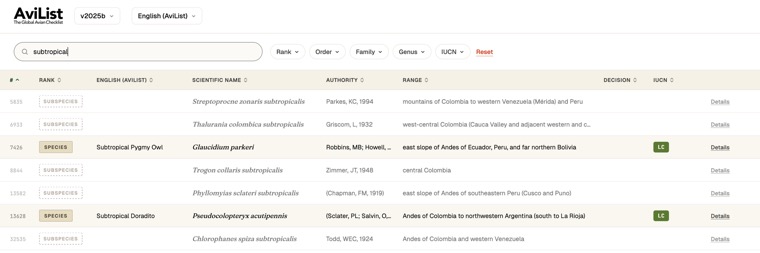
“Southern” for this taxon. The name “Subtropical” was suggested by Josh Beck,
and the non-Andean portion of the range of Subtropical Doradito mirrors that of
this tyrannulet (but not that of the Subtropical Pygmy-Owl). The definition of
“subtropical” given by Google AI is: “geographic and climate zones immediately
north and south of the Earth's tropics, typically located between 23.5° and 35°
to 40° latitude”, so it is reasonably descriptive of this species’ range.
We
are under a bit of a time crunch here, as the AviList ENC needs to finalize
names by July 15th. To keep things simple, this proposal offers two
options: voting NO indicates that you are voting to retain Southern
Beardless-Tyrannulet for Camptostoma obsoletum. YES is a vote for
Subtropical Beardless-Tyrannulet.
Andrew
Spencer and Pam Rasmussen, June 2026
Vote tracking chart:
https://www.museum.lsu.edu/~Remsen/SACCPropChart1044+.htm
Comments from
Donsker (voting for Bonaccorso): “I completely buy the argument presented
by Andrew and Pam in SACC proposal 1078 that it would be wise to reconsider the
English name of Camptostoma obsoletum (sensu stritco).
I vote YES for their suggested English name Subtropical Beardless-Tyrannulet.”
Comments
from Zimmer: “I vote
YES to change the English name of Camptostoma obsoletum (sense stricto)
to Subtropical Beardless-Tyrannulet, for the reasons stated in Proposal 1078. I don’t remember that name suggestion coming
up during our previous considerations, but I like it, and it seems entirely
appropriate and not too unwieldy.”
Comments
from Rasmussen: “I vote YES for Subtropical, which for the reasons in the
proposal seems a far better name than any of the others that have been
considered. The main downside that I can see is the number of syllables (10),
but likely when birding I'd think people will usually just say ‘Subtropical’ or
‘Beardless’ anyway.”
Comments
from Josh Beck (guest voter): “Just to give credit correctly, Subtropical wasn’t
my idea; it came from friends in Argentina and Uruguay who were really happy to
have been consulted. I merely passed it along! So, I’m personally very happy
that a name that came from birders / ornithologists in C. obsoletum’s
range is presented as an option.
“In any
case I like Subtropical essentially as well or better than any of the other
options and am happy with it as the least problematic of all options suggested
so far, so I vote YES to use Subtropical instead of Southern.”
Comments
from Remsen: “YES in
the spirit of compromise. Given that the policy that in parent-daughter splits,
a daughter should not retain the parental name, I’m normally strongly in favor
of that, i.e., the ‘one taxon, one name’ principle, but it’s a guideline, not a
rule, and in this case “Southern” was a good name in my opinion not only
because it was accurate but also because it was a nice foil to ‘Northern
Beardless-Tyrannulet’.
“As with
the majority of English names, it’s easy to find fault but usually difficult to
find something better. In this case,
‘Subtropical’ could apply just as well to some other Camptostoma,
including Northern, but so be it.”
Comments from Rosenberg: “I vote YES
for Subtropical. I agree with Van that Southern still seems like a more
accurate name - but I also understand the issue of confusion with older field
guides - although that is an issue with many newly named species (at least in
terms of not having the accurate name - but perhaps not in actually
representing the WRONG species). So as a compromise, I am fine with using
Subtropical (although the word Subtropical is often used to delineate an
elevation difference from the “Tropical” zone - as in Subtropical Pygmy-Owl).”
Comments from
Areta: “I am not sure of why this has
become a Subtropical yes/no proposal. There are only 2 other
"Subtropical" birds, both of which have distributions largely
encompassing the Andes, in the "Subtropical zone": Glaucidium
parkeri and Pseudocolopteryx acutipennis (the latter
having apparently recently expanded south and east to colonize the lowlands of
Argentina, as we discussed here).
So, if Subtropical is to mean anything more or less precise, the third
"Subtropical Beardless-Tyrannulet" would be complete mismatch to what
the other names were referring to. I
vote NO to Subtropical and vote in favour of Meridional Beardless-Tyrannulet.
one of the names that was an option in previous proposals. Incidentally, I am perfectly fine
with nominate obsoletum retaining Southern (as current SACC
treatment), and I am also perfectly well with obsoletum being called
Austral (as in AviList votes). So, I think that the current proposal is a step
backwards in the naming of this cute little bird that is close to my heart.”
Comments from
Spencer: “I obviously vote YES for Subtropical.
While it, like anything else we've come up with, has some issues, I think it is
the best option voiced so far. Thank you to Josh for reaching out to so many
birders in Argentina, Brazil, and Uruguay, and coming back with that option! To
be fair, I was also, in the end, ok with Austral (but didn't like it). In
response to Nacho on Meridional, I think that word is just too obscure to be a
name I'm happy voting for. If the species was some obscure tapaculo or
tyrannulet on an isolated mountain range somewhere, I might be more willing to
choose an essentially unknown word as the name. But for such a common species
I'd rather avoid it.”
Additional
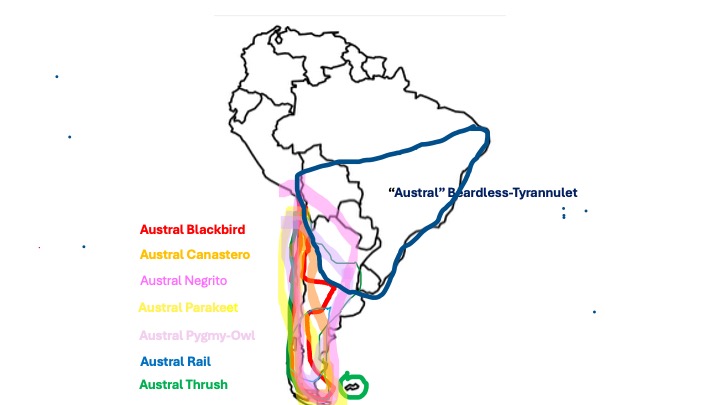
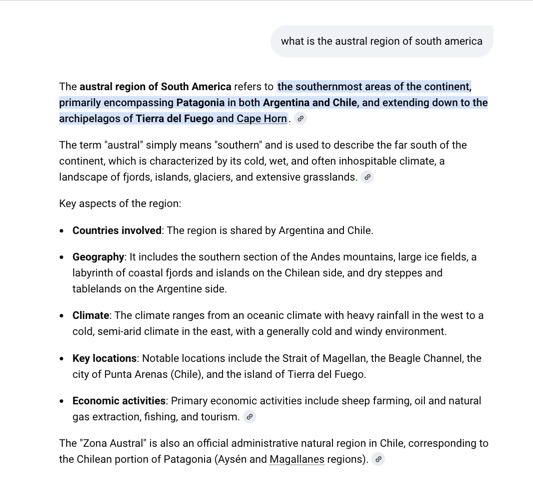
comments from Remsen: “Because
‘Austral’ has emerged again, I again provide the graphics that show why
‘Austal’ is not just bad but ‘wrong’, and it would corrupt the tight
connotation it has with the 7 SACC species already called ‘Austral Something’.”
Additional
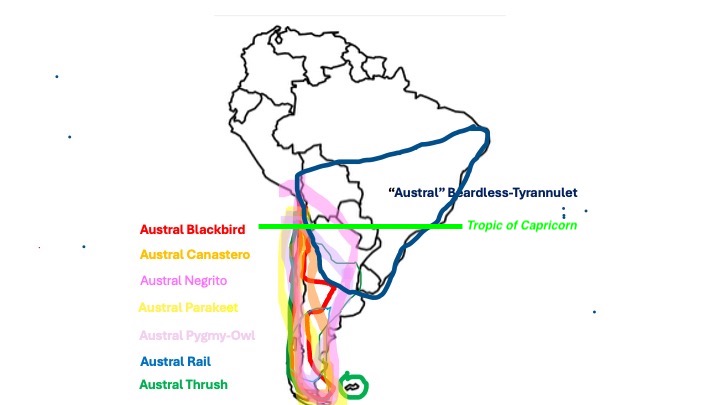
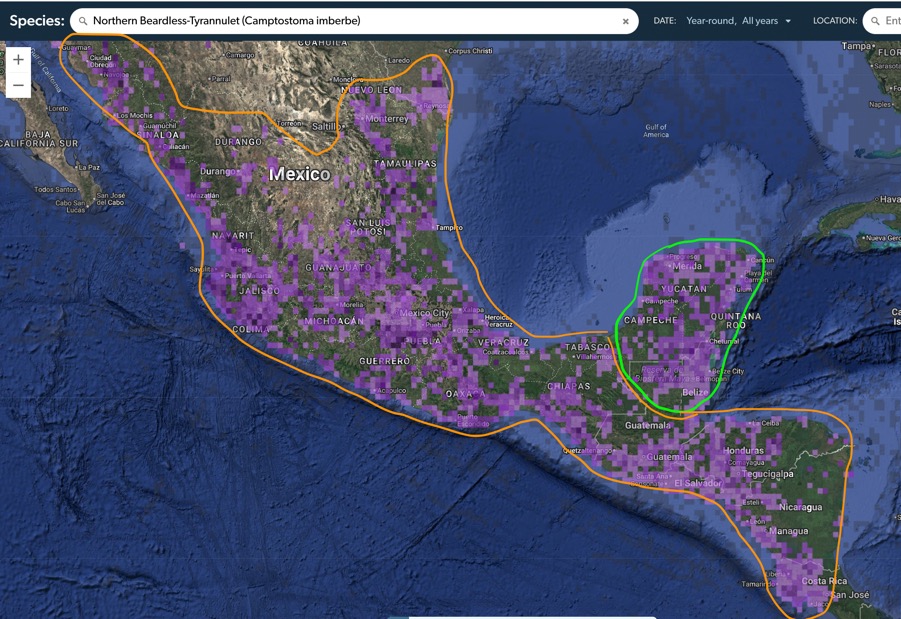
comments from Areta: “I have here added the missing Tropic of Capricorn to Van´s
map. As can be seen, the species could have been more aptly called Tropical, if
one follows the arguments against Austral (which in my mind just equates to Southern). The range of C. obsoletum in the
"subtropics" is even smaller than shown, as it does not occur in the
huge Puna Plateau area included in the sketch (I know it is just a fast
sketch). I also don´t think that the traveler birder argument should be the
main concern here: we should focus on a much broader audience of users of these
names. Given the broad geographic range of obsoletum, it makes perfect
sense to retain Southern for the nominate, widespread species. As such, the
pretended accuracy of Subtropical vanishes and it does not match what other
concepts of Subtropical have been applied to South American birds.”
Additional
comments from Donsker: ““Nacho’s map helps. Perhaps we’re overlooking an obvious
(albeit unlovely) name ‘Southeastern Beardless-Tyrannulet’.”
Additional
comments from Rasmussen: “I still think that Subtropical is
the best name we have for Camptostoma obsoletum. It gets the idea across
that the distribution of this species is somewhat removed from the equator, and
to me is at least as, if not more, helpful than Pacific, for example, for
something that occurs along a small portion of one side of the Pacific Ocean
(but I definitely am not suggesting we revisit that one!). I checked
iNaturalist for usages of Subtropical in the names of other organisms, and
there are several, but none have very similar distributions to C. obsoletum.
If we choose to use the dictionary definition of Subtropical, then this bird
gets rather too far into the tropics for it to be a perfect name, but as we all
know perfect names for drab creatures are hard to come by. In thinking of other
usages of Pacific for bird names, and then comparing it with how radically
different those usages are to this proposed usage of Subtropical I think its usage
is completely defensible. Southeastern would be serviceable, and Argentine
would be fine too, but I continue to vote for Subtropical."
Additional
comments from Gary Rosenberg: “NO. I guess - if you want me to choose between
Subtropical and Southeastern, I would choose
Southeastern - mainly because the other “Subtropical” birds REALLY refers to
elevation on latitude - as in Subtropical Pygmy-Owl - and “Subtropical Cacique
(which should still be a species in my opinion. Southeastern is more accurate -
but is getting closer to my panned suggestion of “Southern-most) :-) Still, I
like it better than Subtropical - I think!”
Additional
comments from Remsen: “NO. I
also like Southeastern better. I have
the same problems with the elevational interpretation of Subtropical as Nacho
and Gary, despite the Subtropical Doradito, regardless of the lowland component
of its distribution. My generation is
strongly influenced by the use of Subtropical Zone in Meyer de Schauensee’s
range descriptions and elsewhere. I like Southeastern in a lesser-of-evils and desperate-times:desperate-measures sort of way. Although a
bit unconventional, it is the most accurate description of its geographic
position in the complex, including Northern B-Ts, and also because it retains a
slight connection to Southern B-T.
Comments
from Marshall Iliff: “I
could not agree more strongly with the need to find an alternative name that
avoids re-using Southern Beardless-Tyrannulet for a new species concept with a
massively restricted range. The fact that it retains the scientific name makes
it even worse, since the average user would have no way to distinguish the
pre-split concept from the post-split one. This is the posterchild for the
worst-case scenario for re-use of an English name, so I am strongly in
support of this effort to revisit this issue and find an alternative,
difficult though it may be. As the person on the front lines of eBird data
quality issues that arise from name confusion, I will freely admit that those
areas of confusion are front of mind for me and the use of a new English name
(and non-English name!) for these birds will be a very helpful signal that
something important has changed.
“Finding the *perfect* geographic name is often what
derails discussions of English names for birds. I have long ago become
comfortable with "good enough" names, especially when they do convey
something useful like the geographic center of the range or a particularly
distinctive aspect of a species range relative to congeners. I don't lose sleep
over Chihuahuan Meadowlark even if its range extends well beyond the Chihuahuan
Desert--it still conveys something useful that is a center of the species'
range and is distinctive relative to the other congeners. Panama Flycatcher,
Mexican Jay, Canada Warbler, Brazilian Teal, Peruvian Meadowlark, etc. all have
varying degrees of imperfection, but still convey something that is helpful for
those birds.
“In this case, I would have been fine with Austral,
Argentina, or Subtropical.
“I also am anxious for resolution on this case and see
a consensus emerging, so am happy to add my voice in favor of Subtropical
Beardless-Tyrannulet. I find it distinctive and helpful, as it is the only
Beardless-Tyrannulet in South America to reach the Subtropics. This is not to
be underrated, and the other names all orient someone to the correct portion of
the new Camptostoma species' ranges, so this would be nice to treat in
the same way. Subtropical is a name with
precedent and feels familiar since, for the moment at least, we do have the
precedent for two birds (Doradito and Pygmy-Owl) that refer to the Subtropics
in South America. So, this would be a consistent there and familiar
construction.
" ‘Subtropical’ obviously applies also to
Subtropical zones and climates to the north and south of the Tropics. One could
reasonably propose calling Northern Beardless Tyrannulet the Subtropical
Beardless-Tyrannulet (although I certainly would not do that!).
“I agree with Andrew that Meridional feels too
unfamiliar. I like Southeastern less, but I can't deny that it is serviceable.
I guess I dislike it just because it feels unfamiliar and blander. Also, while
it is the Southernmost and easternmost in the genus, I could see confusion once
we have more than one Beardless-Tyrannulet in North America, since C. thyellophilum once it is split (and it will be split, I
believe) does occurs well to the south and east, if not the southeasternmost
population of all. Obviously, something like Yucatan Beardless-Tyrannulet would
apply there, but still, there is always the question of ‘Southeastern relative
to what’? This feels a bit trickier across an 8-way division of two species
than it might if we expected Northern to remain intact as one species. But I
would not harp on this for too long; Southeastern is fine and if it wins the
day, so be it.”
“I also can't really deny the arguments that
Subtropical invokes elevation for some more than it does latitude, but this
resonates less with me, and in the end I just find Subtropical a more helpful
option and especially so when considered relative to all other Camptostoma.
“If I approached the options mentioned in the latest
round as a ranked-choice voter (and if I ignore austral altogether) I would
vote:
1)
Subtropical Beardless-Tyrannulet
2)
Argentina Beardless-Tyrannulet
3)
Southeastern Beardless-Tyrannulet
4)
Meridional Beardless-Tyrannulet”
Comments
from Stiles: “To be brief, NO to Subtropical (therefore, YES to
Southeastern)?
Additional
comments from Beck: “To
return to this and weigh in again now that more options are presented, I am
basically sympathetic to all arguments against all proposed names thus far, as
well as being basically sympathetic to all arguments in favor of all names.
“Personally,
I have no problem with Subtropical being used for a foothill bird, for a
southern cone bird, and for a south of the Amazon bird. The name fits all three
for me. English names don’t have to be perfect.
“I also
have no problem with Argentine being used for a bird that isn’t limited to
Argentina. English names don’t have to be perfect.
“I have no
problem with Southeastern despite it being bland and despite it being a
cardinal direction which appears to be distinctly less popular in the
concurrent Tunchiornis proposal. English names don’t have to be perfect.
'
“I have no
problem with Meridional despite it being a more obscure word and despite not
clarifying which Meridian. English names don’t have to be perfect.
“None of
these names is perfect and is everyone’s first choice, but none of them is
terrible or particularly problematic (at least in my view). I don’t mean to
speak for Van, but it feels like we have very near consensus on Subtropical but
are at a tipping point of a whole new proposal again and I might venture to
guess Van isn’t keen on that, and I know Marshall and the rest of the AviList
folks are keen to see this resolved from a timing standpoint.
“So, I
maintain my vote for Subtropical in the interest of resolving this. There is no
perfect name. We have many serviceable names that I do not envision being
problematic for the vast majority of people out there. If the balance tips to
any other of Argentine, Southeastern, or Meridional, or to any other previously
suggested name (bar Southern) or to a new name in a new proposal, I am inclined
to vote with the majority. I don’t see enough advantage in any one of these
names over any other to die on a hill here.”
Comments
from Lane: “So as
far as the English name for C. obsoletum (sensu stricto), it seems we’re
spinning our wheels. I am firmly against retaining “Southern” for this species
as I think that invites far too much unnecessary confusion in the
pre/post-split applications of that name. “Subtropical” is actually a fairly
good idea in my mind, even if it has not been applied to a species of this sort
of distribution before (by the way, how many other species are there with a
similar distribution that provide so little fingerholds on English names? It
seems like a pretty unique case to me!). I still say that boxing ourselves in
on the application of “Austral” is a big mistake, as we may find it a useful
term in light of future splits to come of similarly Neotropics-wide species
that will be split into 5-10 daughter species with birds with little/no
morphological characters and little useful distributional help to adopt into
their future monikers. But at this point, we are beating a dead horse on that
one, and I have no need to repeat my arguments from before on the subject. So,
that is a long-winded way to say: I’m fine with adopting “Subtropical” for C.
obsoletus. My next top choice is “Austral”. Although cumbersome, I can
accept “Southeastern” as my next choice. Following that, I am ok with
“Argentine” as my 3rd choice. I truly don’t understand the term
“Meridional” in this discussion as to me that term refers to longitude (e.g.
“Prime Meridian”), and does not seem appropriate to mean “southern”. I hope we
can put this to bed at this point.”
Comments
from Donsker (who has Bonaccorso vote): “Although it's pretty hard to get enthusiastic about
the mundane nature of the name "Southeastern Beardless-Tyrannulet",
at least it is an accurate description of the species entire range relative to
all of the other species in this complex. As Pam has said, it's at least
"serviceable", if not lovely.
" ‘Subtropical’
remains acceptable to me (I did vote to support it initially), but I don't
think it's preferable to ‘Southeastern;’ as a descriptive adjective since so
much of the range of this species lies well within the tropics. Further, as
others have already pointed out, ‘subtropical’ has an elevational connotation
for the other South American species for which it is used which would not apply
in this case.
“My
ranking of the proposed names would be:
1.
Southeastern Beardless-Tyrannulet
2.
Subtropical Beardless-Tyrannulet
3.
Meridional Beardless-Tyrannulet”
Note from Remsen: The voting up to this point
produced a tie between Southeastern and Subtropical. I asked Mark Robbins, a former English name
voter who has field experiences with almost all the taxa and 50 years of field
experience with Camptostoma from Mexico to Paraguay to be the tie-breaker.
Below is his vote.
Comments
from Robbins: “Of the options now given, my first choice would be
Southeastern....far from perfect as pointed out by others. My bias against
Subtropical is that I usually associate that with elevation, although I
recognize that it can refer to latitude.”