Proposal (1081) to South
American Classification Committee
Recognize newly
described Sakesphoroides niedeguidonae as a species
Background: Our current
classification treats Sakesphoroides cristatus as consisting of a single
species, which is treated as monotypic in all classifications. The current SACC note is as follows:
2ggg. Cerqueira et al. (2024)
named the southern population of Sakesphoroides cristatus as a new
species: Sakesphoroides niedeguidonae.
SACC proposal badly needed.
New
information:
In an exceptionally detailed study, Cerquiera et al. (2024) analyzed geographic
variation across the range of the caatinga specialist Sakesphoroides
cristatus using vocal, plumage, ecological, and genetic data.
Vocalizations
Cerquiera
et al. (2024) analyzed variation in recordings of 95 individual Loudsongs and
29 calls, and measured an array of standard characters from sonograms. They
found diagnostic differences in the loudsongs between the populations separated
mostly by the Rio São Francisco:

Seven
other vocal characters differed statistically significantly between the two
populations, but none were diagnostic and thus of no direct taxonomic
importance.
Examples:
niedeguidonae from Piauí by
Jeremy Mimms:
cristatus from s. Bahia
by Mateus Gonçalves Santos
The
songs do not sound particularly different to my ear; I cannot detect the
differences that are reflected in the shape of the Sharp Notes or Raspy Notes.. Playback experiments would be needed to see
if they function in recognition, but the songs are sufficiently similar that I
would expect some degree of response to each other’s songs.
Plumage
color
Cerquiera
et al. (2024) analyzed plumage characters in 92 study skins. They used the Smithe 1975 color guide to
assess color on the crown, back, throat, breast, and tail, and they also
characterized the presence of barring and streaks. They also studied the type series using high
quality digital photos.
No
geographic structure was found in male plumage, but in females they discovered
a diagnostic difference in tail patterns.
Here is part of their Fig. S1:
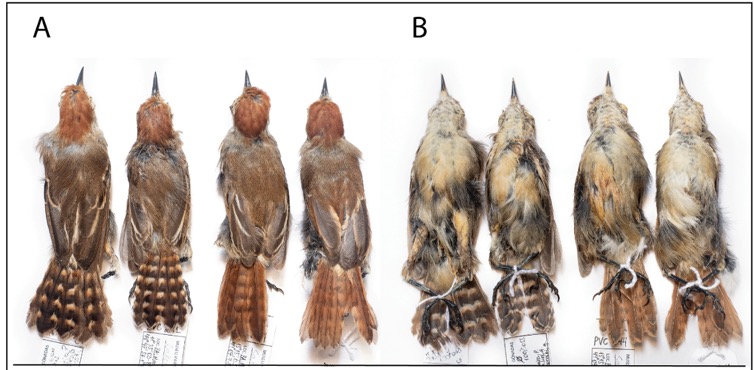
And
here is their Figure 1 showing the geographic distribution of the female tail
pattern:

Morphometrics
From
a sample of 54 male and 24 female study skins, Cerquiera et al. (2024) took
seven standard measurements. They found minor but statistically significant
differences in tail length and bill length, but these were not diagnostic and
thus of no taxonomic value.
Genetic
data
Cerquiera
et al. (2024) analyzed 58 tissue samples from throughout the range of the
species and from both sides of the Rio São Francisco. They used DNA sequence
data from two mitochondrial genes (ND2 and cyt-b) and one nuclear marker (G3PDH).
They found that the two populations
defined by the female tail pattern formed two separate clades:

Most
importantly, the two clades are in direct contact with no sign of gene flow: “Both clades are in close
and direct contact on
the west bank of the middle SFR in Western Bahia.”
Taxonomic
Recommendations
The
authors described a new species, Sakesphoroides niedeguidonae, for the
north bank population.
The
etymology is as follows: “It
is our pleasure to name this species in honour of Niède Guidon, a Brazilian archaeologist who in 1970's
explored the largest and oldest concentration of prehistoric sites in the
Americas. Niède's efforts helped to create the Serra
da Capivara National Park in Piauí state, where her
research found evidence of artefacts that have provoked a reevaluation of the
traditional theories about human settlement in the Americas. Moreover, she is a
symbol of power and persistence in preserving the Caatinga environment not just
for archaeological purposes but also considering biodiversity and local human
communities, highlighting the Caatinga as a singular place in the world, which
has inspired us every day.”
Distributions
are as follows:

Discussion
and recommendation: This is a model study in my opinion, from dense
geographic sampling right down to minor details such as examining the type series.
As for the taxonomic decision on species limits and recognizing a new species,
this is a straightforward one because the authors established a major genetic
break in the area in which the two are in direct contact, without the
constraints of the river barrier, with no evidence for gene flow. Those data require species rank for
the newly described taxon, even without any other data. Parapatry without gene flow is direct
evidence for species rank. Mitochondrial DNA has its problems in terms of
determining population-level phylogeny, but here we have a great example of its
taxonomic utility in terms of detecting gene flow in parapatry/sympatry. All of
the other data sets are of biological interest for the study of the speciation
process, but in this case unnecessary in terms of taxonomic rank – no need for
the now fashionable “integrative taxonomy” approach, which to me smacks of
numerical taxonomy. Once one has evidence for no gene flow, there is no need to
“integrate” any other data into the taxonomic decision, regardless of their
intrinsic biological value.
So, a strong YES to recognizing newly
described Sakesphoroides niedeguidonae Cerqueira, Gonçalves, Quaresma,
Silva, Pichorim, and Aleixo, 2024.
English
names:
The authors used “Northern Silvery-cheeked Antshrike” for S. niedeguidonae
and “Southern Silvery-cheeked Antshrike” for S. cristatus. This describes their relative geographic
position and also refers nicely to the north bank/south bank separation
(mostly) of the two by the Rio São Francisco. Dull, yes, but apt and useful. If
anyone has any objections to adopting these names, make that known in your
comments. Retaining Silvery-cheeked as a
group name is helpful in sorting out this pair from the dozens of species
called Something Antshrike. Alternatives
based on female tail pattern would produce unacceptably cumbersome names if the
group name were retained and would make no sense without the group name for
context. But one could go with something
like Zebra-tailed Caatinga Antshrike and Rusty-tailed Caatinga Antshrike if the
group name were change to something that emphasizes both the plumage difference
and the habitat. If you have an
appealing alternative to the official proposed names, speak out and write a
proposal.
References:
CERQUEIRA, P.V., G. R. GONÇALVES, T. F. QUARESMA, M. SILVA, M. PICHORIM,
AND A. ALEIXO. 2024. A new antshrike (Aves: Thamnophilidae)
endemic to the Caatinga and the role of climate oscillations and drainage shift
in shaping cryptic diversity of Neotropical seasonal dry forests. Zoologica Scripta. 2024: 1–22.
Van Remsen,
July 2026
_________________________________________________________________________________________________
Vote tracking chart:
https://www.museum.lsu.edu/~Remsen/SACCPropChart1044+.htm
Comments
from Rafael Lima: “Although
Cerqueira et al. (2024) clearly demonstrate two distinct taxa within Sakesphoroides
cristatus, I do not find the case for ranking them as separate
biological species as convincing as presented in the proposal.
“Genomic studies have repeatedly shown that strong
mitochondrial structure can coexist with extensive introgressive hybridization,
meaning that mitochondrial breaks are not reliable evidence of biological species
limits, even in sympatric samples. In antbirds, the hybrid zone between Rhegmatorhina
berlepschi and R. hoffmannsii is the
clearest cautionary example. I therefore do not read the genetic results of
Cerqueira et al. as clear evidence for two biological species. If anything,
they may suggest caution in the opposite direction. Cerqueira et al. actually
note that the pattern of putative secondary contact is supported by a phylogeny
“mainly based on the mitochondrial dataset,” with the only nuclear gene
providing “inconclusive evidence,” and that specimens phenotypically assigned
to S. niedeguidonae from Raso da Catarina fall within the S. cristatus clade. They explicitly state that this
discordance between mitochondrial clade and plumage may reflect introgressive
hybridization, which I find the most plausible explanation.
“Furthermore, the vocal evidence also seems less
decisive than implied. It is unclear to me whether the vocal traits are truly
diagnostic in the sense of being non-overlapping. A previous vocal analysis
suggests that variation is not simply two discrete types, but includes a
latitudinal cline (Capelli et al. 2020, J. Ornithol. 161:873-884).
“I think denser sampling of the contact zones, using
genomic markers capable of detecting introgression, is needed before concluding
that these two taxa are separate biological species. By identifying contact
zones, Cerqueira et al. (2024) paved the way for such studies, which should be
straightforward since the tissue samples already exist (used by Cerqueira et
al.).”
Response
from Remsen: “Good
points, Rafa, but in my opinion Cerqueira et al. place burden-of-proof on there
being free gene flow between the two populations. The phenotypic signal is that
there is virtually no sign of free gene flow between the two – otherwise, there
would be a hybrid zone dominated by intermediate phenotypes, as in the Rhegmatorhina
situation, with many specimens from the general region showing a signature of
gene flow in their mtDNA. Some gene flow does not negate species rank in the
BSC or most species concepts. If future denser geographic sampling in the
critical region produces evidence for unrestricted gene flow in terms of, say,
a hybrid swarm, then species rank can be overturned. Upon further review, I
agree with your points on vocalization – after listening to more recordings,
I’m not sure I can discriminate between the two.”
Comments
from Robbins: “NO. I agree that the authors have done an exemplary job of
presenting a broad spectrum of data. However, when I listened to the supposed
differences in the loud song I was surprised how similar they are! At
that point, I revisited the publication and didn't see any playback experiments
which one would think would be critical given how similar the vocalizations,
plumage morphology and the potential limitations of the mitochondria data (as
pointed out by Rafael Lima). Thus, I have doubts about whether niedeguidonae
should be treated as a species. Yes, female tail patterns appear to differ, but
does that merit more than just subspecific status? So, for now, I vote NO
until there are playback experiments.”
Comments from Areta: “NO to recognizing Sakesphoroides
niedeguidonae as a separate species, but I´d vote yes to granting it
subspecies status. The work is very comprehensive, and the data presented are
clear. I wish the authors would have been more detailed in how they obtained
the quantitative acoustic data: I don´t deny that there seem to be two main
vocal types, but I don´t think that typology is so clearcut, and the
differences seem (subjectively, to me) unlikely to be a reproductive barrier.
Especially in antshrikes that are known to vary geographically quite a lot and
in which the number of notes can also vary widely. Capelli et al. (2020)
indicated that while there is an effect of the São Francisco River in the
geographic variation of songs, the differences are not clearcut, and song
features also covary with latitude. Thus, geographic variation is complex and
does not seem to be aptly described by the simplified two types described by
Cerqueira et al. (2024).
“The Raso da Catarina situation (with specimens
looking like niedeguidonae but genes linking them to the cristatus clade)
is especially problematic, while the situation in western Bahia (where genes
and plumage, and voices?, align correctly in birds separated by 40 km) would
seemingly provide evidence in favour of their
treatment as separate units. All this can be seen in the Figure 3 (posted by
Van here as well): the Raso da Catarina is delimited by the red square, and
western Bahia by the black square, with the mismatched plumage/genes samples
indicated in red font in the tree.
“Before committing to the split, I´d like to see more
evidence indicating lack of response to playback and genomic data at the
contact zones. The system is very neat, and Cerqueira et al (2024) did a very
nice work to advance our understanding.”
Comments
from Naka: “NO. Pablo
Cerqueira and co-authors unveiled a very cool pattern that we are currently
studying in detail, with more species and more genomic markers (UCEs).
“My
student Giovanna Couto, who recently defended her master thesis in Pernambuco,
found that half of the species she studied (5/10), presented clear
phylogeographic structure across (at least part of) the Rio São Francisco.
“The mtDNA
pattern found by Pablo remains consistent using the mitogenomes and nuclear
markers (~5000 loci), and in my view there are clearly two lineages in the
Caatinga.
“There are
three issues, however, that refrain me from fully endorsing the new form as a
full species.
“First,
nuclear data show signs of gene flow among samples on both sides of the lower
Rio São Francisco. In fact, it presents a high and significant isolation by
distance pattern (R=0.7, and P> 0.0001).
“Second,
we found a lot of variation in the female's tail pattern, from very barred, to
virtually plain, including all possibilities in between.”
“Finally, the
vocal variation is rather subtle (to me). Despite the obvious differences in
note shape (shown in the spectrogram), I found both sounds rather similar.
Honestly, I doubt a bird from the N would not come to the sound of the southern
voice, and vice versa. I guess we could set up playback experiments on our next
field trip, but I would be surprised if birds discriminate between N and S
populations.
“I will
look closely at this decision, as Sakesphoroides is one of the many
cases presenting a rather similar pattern, which I find fascinating.
“For the
time being, I vote for retaining S. niedeguidonae as a subspecies of S.
cristatus, and foresee that similar discussions will appear in the near
future with other lineages that present similar phylogeographic patterns.”
Comments
from Zimmer: “YES, although somewhat tentatively. Although I agree with others that the vocal
distinctions are very subtle (to my ear), the spectrograms tell a different
story with respect to note shape, particularly as regards the introductory
notes in the respective loudsongs. As
Luciano voiced, I would be surprised if playback experiments didn’t result in
each taxon showing at least some response to playback of the other. However, I still remember being with Ted
Parker on the banks of the Rio Cristalino (MT,
Brazil), when I had just glimpsed a male Glossy Antshrike (Sakesphorus
luctuosus) dive into a thicket at the edge of the river. Neither Ted nor I had any Glossy Antshrike
tape at our immediate disposal to draw the bird out for our group. Ted’s comment was “It doesn’t matter, play
Species X (I can’t remember if it was Sakesphorus canadensis, or if it
was a Thamnophilus species, such as palliatus) – any male
antshrike worth his salt should still respond!”
And it did, popping right out of cover and singing away, with crest
elevated. My point is, that antshrikes
at least, seem to respond rather generically to vocalizations of other
antshrikes, including those of other species, or even other genera. Given this, playback trials in which there is
no response may be more meaningful than trials in which one population responds
to playback of another population. As
regards plumage differences, the lack of geographic structure in male plumage,
accompanied by diagnostic plumage distinctions between females of the same
populations, fits a common pattern among species-pairs of antbirds. I see from his comments that Luciano and his
students found a lot of variation in the tail patterns of these populations of Sakesphoroides,
and I have no reason to doubt their conclusions. However, based on my own observations, and on
a perusal of Sakesphoroides photos archived on the Brazilian website
WikiAves, the distinctions in female tail patterns described by Cerqueira and
co-authors seems to hold up on opposite banks of the Rio São Francisco. Ultimately, I am persuaded by Van’s arguments
regarding lack of phenotypic evidence of free gene flow (intermediate
phenotypes or clear hybrid zones) despite rather extensive parapatry or near
parapatry. Definitely not a perfect
case, by any measure, although the authors are to be commended for having dense
geographic sampling and a highly detailed approach to their analysis.”
Comments from Bonaccorso: “NO. As already discussed by the other members, it
is important to sample the contact zone using sufficient and appropriate
nuclear markers to confirm whether these are distinct lineages with no or very
limited hybridization, or the extremes of a continuum along an
isolation-by-distance cline.”