Proposal (1082) to South
American Classification Committee
Resurrect the genus Oxypelia
for Columbina cyanopis
Background: Our current
classification treats this species as Columbina cyanopis, as in all
classifications in recent decades. The
current SACC note is as follows:
13. Columbina cyanopis was formerly (e.g.,
Peters 1937, Pinto 1938, Hellmayr & Conover 1942) placed in a monotypic genus Oxypelia; most authors have followed Goodwin (1959b) in merging it
into Columbina, but see Johnston
(1961); it differs from other Columbina
species and is similar to Claravis in
having an attenuated first primary (Baptista et al. 1997). Vogeley
et al. (2026) showed using genetic and phenotypic data that cyanopis is sister to Paraclaravis and recommended resurrection of Oxypelia. SACC
proposal badly needed.
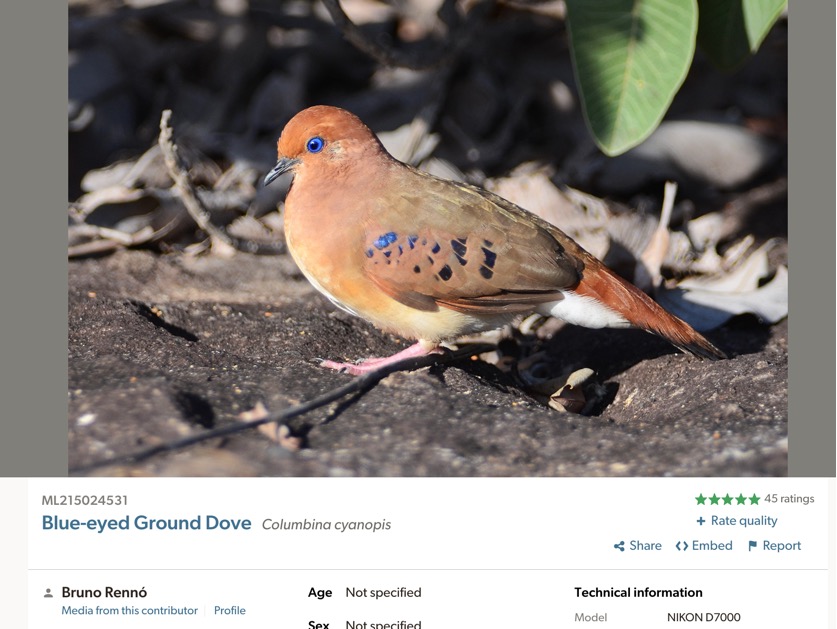
New
information:
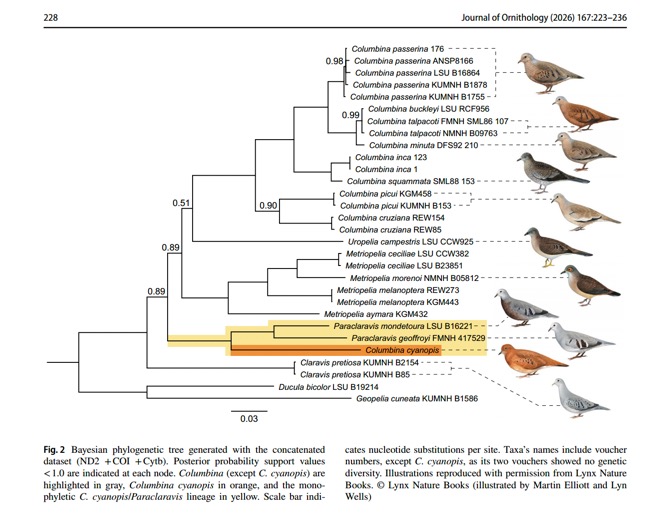
Vogeley et al. (2026) sequenced 3 mitochondrial genes
(ND2, COI, Cyt-b) to produce the first phylogenetic hypothesis for newly
rediscovered and critically endangered Blue-eyed Ground Dove (Columbina cyanopis), with an estimated population of only 20
birds; see [reference needed!] for the details of this exciting discovery of a
species that had beem thought by some to be extinct.
The
genetic data showed that cyanopis was not a Columbina but rather the
sister to Paraclaravis:
Discussion
and recommendation:
The
genetic data leave only two possibilities for phylogenetic classification:
either resurrect a monotypic Oxypelia Salvadori, 1893, for cyanopis
or include in Paraclaravis 2018, Sangster et al., in a resurrected Oxypelia.
Vogeley et al. provided the following rationale for
former,. First, they emphasized the ecological distinctiveness between the two
bamboo-specialized, highly vagile Paraclaravis and the rounded-winged,
sedentary cyanopis, as quantified in their morphological analyses. However, those sort of distinctions can be
found with many genera of birds and are the consequences of adaptations to
different niches. Nevertheless, all three species share an attenuated outer
primary, but otherwise similarities are few. Second, Vogeley
et al. emphasized that lineage age strongly supports their treatment as
separate genera because even if their estimates of divergence times at 10 MYA
are off, that estimate makes the split relatively older than those that mark
most clades of doves ranked at the genus level (and I would add birds in
general). This is the rationale that I favor for resurrecting Oxypelia.
I
would further add that Goodwin (1959) provided no real rationale for the merger
of Oxypelia into Columbina other than “I think that the genera Eupelia, Columbigallina,
and Oxypelia are all best included in Columbina.” Nonetheless,
all subsequent classifications followed Goodwin evidently out of respect for
his expertise on the Columbidae rather than any explicit rationale. So, in my
opinion there was never any reason, much less evidence, for inclusion of Oxypelia
in Columbina.
So,
I strongly recommend a YES on this one.
A NO means placement of Paraclaravis in Oxypelia (or
collapsing both into a greatly expanded Columbina.
References:
VOGELEY, P. H., F. H. HORST, A Â. BISPO, AND·R. CAPARROZ. 2026.
Phylogenetic analysis of the Blue‑eyed Ground Dove (Columbina
cyanopis) based on mitochondrial DNA sequences: revalidating the genus Oxypelia. Journal of Ornithology 167: 223–236.
Van Remsen,
July 2026
_________________________________________________________________________________________________
Vote tracking chart:
https://www.museum.lsu.edu/~Remsen/SACCPropChart1044+.htm
Comments
from Robbins: “NO. If we are going to be consistent in our treatment with
other dove genera, we should place cyanopis in Paraclaravis,
i.e., note divergence time with other genera (Metriopelia). As far
as the wing shape and ecology, as Van points out, we find that diversity
(actually greater in some) in other dove genera. Thus, those differences don't
sway me in erecting yet another monotypic genus. So, NO to recognizing monotypic
Oxypelia, YES to placing Paraclaravis in Oxypelia.
Comments from
Lane: “I’m going to cut the other way
from Mark and vote YES to resurrecting monotypic Oxypelia. Using Metriopelia
as a comparison to me is actually a bit of a red herring as I think that genus
could stand to be split up due to some pretty distinct members! If the
relationships within groups that seemed pretty morphologically conservative in
the past (e.g., Columba and Geotrygon) I am inclined to reward
these fairly distinctive species in behavior and morphology (consider: no
sexual dimorphism in Oxypelia vs. Paraclaravis!).”
Comments from Areta: “YES to monotypic Oxypelia. Of course, we could
place Paraclaravis it in, but this does not seem the best alternative to
me given the deep divergence, structural (primary modifications), and plumage
differences. The fact that the two Paraclaravis are nomadic bamboo-seed
specialists of humid forests adds more drama to the situation.
“Mark has used Metriopelia as a yardstick, and
I was going to mention the same thing except that to raise a point in the other
direction: the genus Leptophaps has been used for aymara (see
Areta & Monteleone 2011), and in the near future Juliana Benitez and I may
argue in favour of its recognition as a separate
genus. Of course, it is nice to have the four Metriopelia in a single
genus, but the group is not as homogeneous as the current generic
classification seems to convey. Yet, this will require a nuanced discussion and
a detailed assessment of several features. Note that Leptophaps (aymara)
is less diverged from Metriopelia (including melanoptera and the
two “Gymnopelia”, ceciliae and morenoi), than the degree
of divergence between Oxypelia cyanopis and Paraclaravis (mondetoura
and geoffroyi)”
Comments from
Naka: “YES. This taxonomic change is
long overdue, and I am all for including this unique creature in its own
monotypic genus. Also, both Paraclaravis are clearly closely related
with many things in common; including cyanopis in that clade will not
only hide its own distinctiveness, as well as downplaying the common features
within Paraclaravis.”
Comments from
Luís Fábio Silveira (guest voter): “YES. We
have two specimens of cyanopis in our collection and a fairly large
series of geoffroyi, which allowed us to directly compare the
morphological characters of these two species. I also know cyanopis in
captivity. Definitively, cyanopis could be placed in its own genus Oxypelia.
It is a delicate, gracile dove, having little in common with the large, nomadic
Paraclaravis. The genetic data provide additional support for this
treatment, and collapsing all species of this clade into a single genus will
hide the distinct evolutionary histories of both Paraclaravis and Oxypelia.”
Comments
from Zimmer: “YES.
Having finally caught up with this critically endangered little dove a
couple of years ago, and getting to spend some time with multiple individuals,
I came away really impressed by their distinctiveness from other
ground-doves. Merging cyanopis
into the same genus with two larger, sexually dimorphic, nomadic,
bamboo-specialist Paraclaravis seems like on bad call on multiple
counts, and, as Luís Fábio says, would only serve to hide the distinct
evolutionary histories of both Paraclaravis and Oxypelia. Given that lineage age strongly supports
treating the latter as separate genera, I view that as confirmation of what
morphology, ecology and natural history are already suggesting as the correct
course of action.”
Comments
from Bonaccorso: “YES, but with a little doubt. I agree that cyanopis
is deeply divergent from Paraclaravis in MITOCHONDRIAL GENES; I hope
that future nuclear-gene phylogenies do not make us reconsider this genus-level
change. On the other hand, the fact that it is quite distinctive in morphology,
plumage, wing structure, behavior, and ecology, combined with the mitochondrial
data, is in line with our integrative approach to the recognition of
supraspecific taxa.”