Proposal (1083) to South
American Classification Committee
Treat the subspecies Crypturellus
obsoletus castaneus as a
separate species from C. obsoletus
Background: Crypturellus
obsoletus is currently treated as a single species with nine subspecies
(e.g., Cabot 1992 HBW, Davies 2002 Ratites and Tinamous); it is broadly but
discontinuously distributed throughout much of hilly, tropical South America. The
subspecies are all fairly similar in plumage to the point that only a single
individual is illustrated in Cabot (1992) and Davies (2002), and only traylori
is illustrated in addition to the nominate subspecies in Del Hoyo and Collar
(2014 HBW). The current SACC note is as follows:
5. Blake (1977),
Sibley & Monroe (1990), and Cabot (1992) noted that the subspecies traylori
possibly deserves recognition as separate species from Crypturellus obsoletus. Laverde-R. & Cadena (2014) found that vocal differences
among subspecies suggests that as many as five species should be
recognized. Proposal
needed.
New
information:
Well, it’s not exactly new information, but I was assuming Daniel Cadena would
write this proposal when the paper came out, and then I subsequently forgot
about it. Laverde and Cadena (2014)
found that the subspecies castaneus differed vocally from the other four
subspecies in their sample. They
analyzed the Short Song of 42 individuals as follows: castaneus (6), ochraceiventris
(10), punensis (8), griseiventris (5) and nominate obsoletus
(13), and here is their figure showing thumbnail sonograms and geographic distributions.
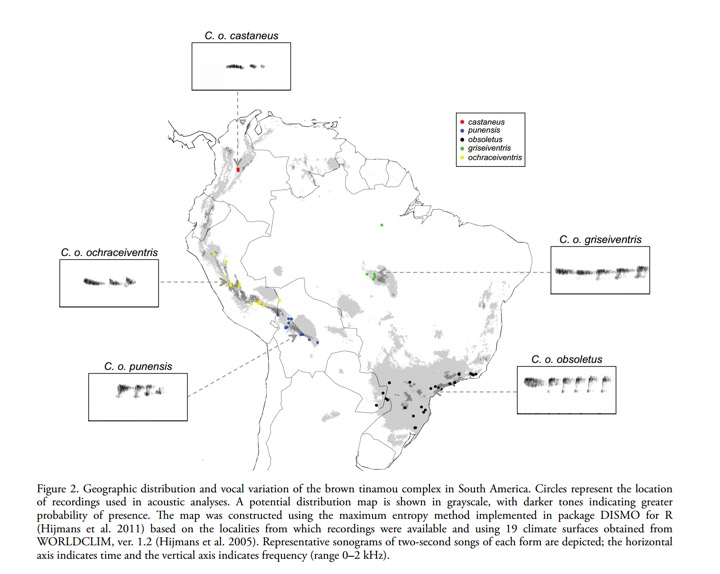
Here
is their overview:
“Brown tinamou songs are highly variable among populations, consisting
of one to nine notes, with greater frequency modulation and variable note shape
between forms. The songs of C. o. castaneus stand out as especially
divergent from those of other populations because they only show three
unmodulated pure tones whereas other taxa show longer and tremulous songs with
more modulated frequencies.”
Their
PCA analysis of song metrics showed that castaneus stood out in
multivariate space from the other four, which formed a continuous cloud with no
taxa occupying exclusive space:
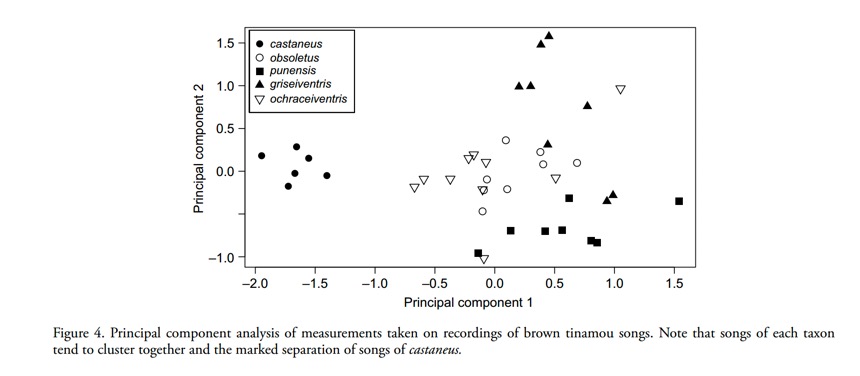
PC1
accounted for 46% of the variation and is associated with “frequency bandwidth of the first, middle and
final note”;
you can see this in the thumbnail sonograms above, with castaneus having
a very narrow bandwidth. PC2 accounted
for 31% of the variation and is correlated “total length of songs and length of
middle and final notes”, but does not separate castaneus from the others.
In summary, “Songs of C. o.
castaneus stand out as distinct from those of other taxa; they tend to have
notes with narrower bandwidth, and shorter songs and notes relative to other
members of C. obsoletus group.”
I
had planned to provide sample recordings of all the taxa, but after roaming
through most of the 224 recordings now on xeno-canto, I got frustrated trying
to restrict the samples to for-certain homologous recordings, i.e. the Short
Song of Laverde and Cadena, and in a number of cases I was concerned about species
identification. Also, gauging by the
number of records, the species gets progressively rare as you go north, i.e.,
recordings of nominate obsoletus are common, punensis fairly
common, but castaneus and the Venezuelan taxa very few. But here is an
example of castaneus, which does indeed sound very different from
anything I found in my roaming and definitely unlike the only taxon familiar (formerly)
to me (punensis):
castaneus
from
Cundinamarca by Oswaldo Cortez:
•
https://xeno-canto.org/119548
Here’s
ochraceiventris from Pasco, Peru, by Andrew Spencer, in which you can
immediately here the broader frequency range compared to castaneus:
•
https://xeno-canto.org/46886
Here’s
traylori from Cuzco, by Dan Lane:
*
https://xeno-canto.org/93395
Here’s
punensis from Santa Cruz, Bolivia, by Dan Lane:
•
https://xeno-canto.org/348783
I
think this must be hypochraceus from Rondonia,
by Luiz Gabriel Mazoni
•
https://xeno-canto.org/189548
Here’s
distant nominate obsoletus, from São Paulo, by Dante Buzzetti
•
https://xeno-canto.org/657841
Laverde
and Cadena summarized their case for species rank as follows:
“The degree of vocal and ecological differentiation between castaneus
and other populations is comparable to, or even greater than, variation
existing among good (i.e. reproductively isolated) species of tinamous (Cabot
1992, Maijer 1996), a criterion often used to treat allopatric populations as
different species under the BSC … “
I
would further emphasize another important finding in Laverde and Cadena: there
are no distinct vocal differences among the various taxa ranked as species in
the Crypturellus erythropus complex, including also C. kerriae.
Therefore, within the same genus, we have conflicting taxonomies if voice is to
be used to delimit species.
The
ecological difference they referred to is the relatively high elevational
distribution of castaneus: the 6 localities that they were aware of had
a mean elevation of 2650 m with only a small standard deviation, whereas 13
localities of ochraceiventris had a mean 1650 m +/- 680, and 13 punensis
localities were 1750 m +/- 470. The
elevation for the type locality of traylori is 1400 m, and for knoxi of the Venezuelan Andes, 1500 m. So, this might
be a real difference, but I would be cautious without a much larger N,
particularly for castaneus itself, for which large gaps in its putative
range remain unsampled. Further, when
scanning through xeno-canto recordings, I found localities for ochraceiventris
at 2400 m and 2650 m, punensis at 2930 m and 2600 m, and even
nominate obsoletus at 2300 m, so the difference might be mostly due
to sampling artifacts.
Discussion
and recommendation: I am conflicted on this one. On the one hand, species
rank for castaneus seems like an easy decision based on voice. It is clear to me that more than one species
is involved. On the other hand, my cautious side leans towards waiting for
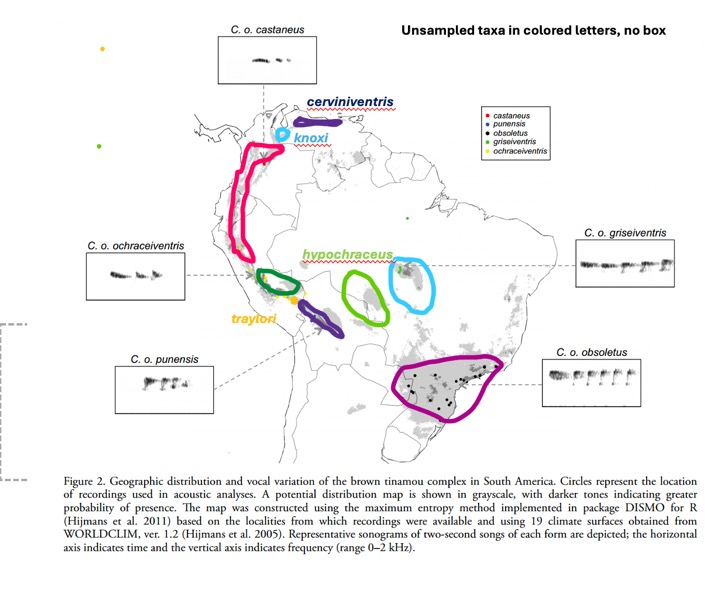
better taxon sampling. Below is the
Laverde-Cadena figure onto which I have inserted very crude outlines of the
ranges of the nine subspecies – note that boundaries are uncertain in several
cases. The point is that the sampling
gaps are an obstacle to a taxonomic revision. For neither of the Venezuelan
subspecies can I find anything in xeno-canto that is clearly homologous to the
Short Song of castaneus. Given
that they are geographically adjacent to castaneus, what we do with them
if we elevated castaneus to species rank? Include them with castaneus
on the basis of geographic likelihood?
Retain them as part of obsoletus despite castaneus geographically
separating the two groups of taxa allocated to obsoletus? Neither of
those sits well with me. So, for now I
have a weak recommendation for NO.
Someone
with more energy than I could quickly reverse that recommendation by doing a
more thorough search for homologous recordings.
Unfortunately, xeno-canto and Macaulay have just a few recordings from
Venezuela, and the ones that sound as if they might be homologous to castaneus
are so different from castaneus that they are either in fact not
homologous or they represent a Short Song that is very different from castaneus. I just don’t have the energy to do what is
needed to try to straighten all this out. What is needed is a thorough analysis
of all recordings available online. This
would make a great side project for someone more experienced than I in
evaluating vocal data.
English
names:
We can worry about that if and when the proposal passes.
References:
LAVERDE-R., O., AND C. D. CADENA.
2014. Taxonomy and conservation:
a tale of two tinamou species groups (Tinamidae, Crypturellus). Journal Avian
Biology 45: 1–9.
Van Remsen,
July 2026
_________________________________________________________________________________________________
Vote tracking chart:
https://www.museum.lsu.edu/~Remsen/SACCPropChart1044+.htm
Comments
from Lane: “This
complex has been on my mind since the realization that “castaneus” is in
Peru! To review: as far as I know, “castaneus’ was first sound recorded
in 1996 by Niels Krabbe in Ecuador (Krabbe and Nilsson 2003; https://xeno-canto.org/238218 ), but this was before the
recordings near the Colombian type locality in 2006 as reported in Laverde and
Cadena (2014). The Ecuadorian recordings were from birds at elevations ranging
from 600-1100m (!) and are of birds with clear voices (contrasting to the
modulated vocalizations of “typical” C. obsoletus known from central
Peru and south to Argentina and east into Brazil). Around the late 1990s/early
2000s, several field observers had been reporting “Pavonine Cuckoo”-like songs
from higher elevations (1800-2000m) on the Abra Patricia road in Amazonas, Peru
(e.g., https://macaulaylibrary.org/asset/616058481, https://macaulaylibrary.org/asset/618017907), and once John Rowlett played me
a long song from this “cuckoo”, it dawned on me that this too could be “castaneus”!
The issue here is: the Ecuadorian birds DON’T sound much like either Colombian
or Peruvian birds, which each sound quite like one-another (and are found at
more similar elevations: compare the Colombian and Peruvian sounds here: https://xeno-canto.org/841090 with https://xeno-canto.org/119548 ), and Ecuadorian birds are found at
anomalously lower elevations. So, what’s actually going on with these
populations? Are Peruvian birds best assigned to castaneus? Are
Ecuadorian birds a new, undescribed taxon? The Amazonas department “castaneus”
in Peru seem to turn over quite quickly to modulated-voiced birds (see https://xeno-canto.org/842432 ) as one heads southeast without any
obvious biogeographic barrier (although habitat may be key, as “castaneus”
voiced birds may be restricted to white sand, stunted forest with impossibly
dense understory, whereas modulated-voiced populations may be in more
“standard” cloudforest habitat… but I don’t know how
these habitat choices compare to true castaneus in Colombia?). It seems
the “castaneus”-voiced birds seem quite local in distribution in Peru
(though a recently recorded bird along the east side of the Utcubamba valley,
well to the south of the Abra Patricia are, also sounds “castaneus”-voiced:
https://macaulaylibrary.org/asset/620804266). At LSU, we have some specimens
that probably represent this form from the Cordillera de Colán, Amazonas, but I
am unaware of any voice recordings from that mountain range to confirm this
assumption.
“The
Venezuelan birds Van discusses seem to have variable voices given the
recordings available (though the distributions of these differing songs appear
to overlap? So, possibly a taxon with wide variation
within it?), but I would wager that they are probably their own species in
their own right, and almost certainly shouldn’t be included within C.
castaneus should it be separated from other populations of C. obsoletus.
“Finally,
there is another situation in southern Amazonia where lowland birds have
considerably lower-frequency voices (https://xeno-canto.org/329092) than nearby Andean birds in Peru
and Bolivia, but the two voice types can be nearly within earshot of one
another across rivers in the Cordillera del Sira in central Peru (Harvey et al
2011) and in the Alto Madre de Dios in SE Peru (pers. obs;
https://xeno-canto.org/93391), strongly suggesting that lowland SW
Amazonian birds (which I think are best labelled hypochraceus,
though these would likely be a taxon under the name C. griseiventris if
a split were to happen) should be separated from Andean taxa based on this
fact.
“All this
is a long-winded way to say: I think we still need a lot more clarification of
the different populations involved before we have enough of a picture to move
ahead with the split-up of C. obsoletus (sensu lato). Laverde and Cadena
(2014), although illuminating, does not address enough of the story to allow us
to make a well-informed decision on where breaks are and which populations to
shuffle under which resulting daughter species. I would wager, however, that we
are looking at 4-6 spp at least here!”
Harvey, M. G., B. M. Winger, G. F.
Seeholzer, and D. Caceres A. 2011. Avifauna of the Gran Pajonal and southern
Cerros del Sira, Peru. Wilson Journal of Ornithology 123: 289-315.
Krabbe, N. and J. Nilsson (2003).
Birds of Ecuador. DVD-Rom. Birdsongs International. https://xeno-canto.org/species/Crypturellus-obsoletus
Comments
from Naka: “NO. The
vocal differences between castaneus and the nominate form are
staggering, but so are the voices of other taxa within the clade. I fully agree
with Van and Dan, in both that several species are likely involved in this
taxon, and that we will make no big advance by simply considering C.
castaneus as a full species, and leaving the rest of the taxa hanging under
an unknown species. This seems like a very simple molecular project to pursue.
“I vote
NO, hoping we can do a better job soon.”
Comments from Areta: “NO. I
agree with Dan and Luciano: Oscar and Daniel have given a first step towards an
understanding of geographic variation and species limits in C. obsoletus, but there are numerous loose ends
that give me pause of making any decision with the data at hand.”