Proposal (1084) to South
American Classification Committee
Treat the Galapagos subspecies
punctatissima as a separate species from Tyto
furcata
Background: The
subspecies of the Barn Owl complex that is endemic to the Galapagos Islands was
formerly treated as a full species, but is currently a subspecies in our
classification. As the name suggests, it was distinguished from other New World
Tyto mostly by the heavy spotting in the underparts, as well as smaller
body size (De Groot 1983). It also has
relative longer wings, thus lower wing loading, producing greater
maneuverability, possible with associated with feeding on more active prey such
as insects (Wagner and Piedrahita 2022), although De Groot found that the
predominant prey items were Black Rats and House Mice (obviously a historical
changed associated with arrival of the humans). Galapagos Barn Owls are less
sexually dimorphic in size than continental birds (De Groot 1983), contrary to
the usual trend for insular offshoots.
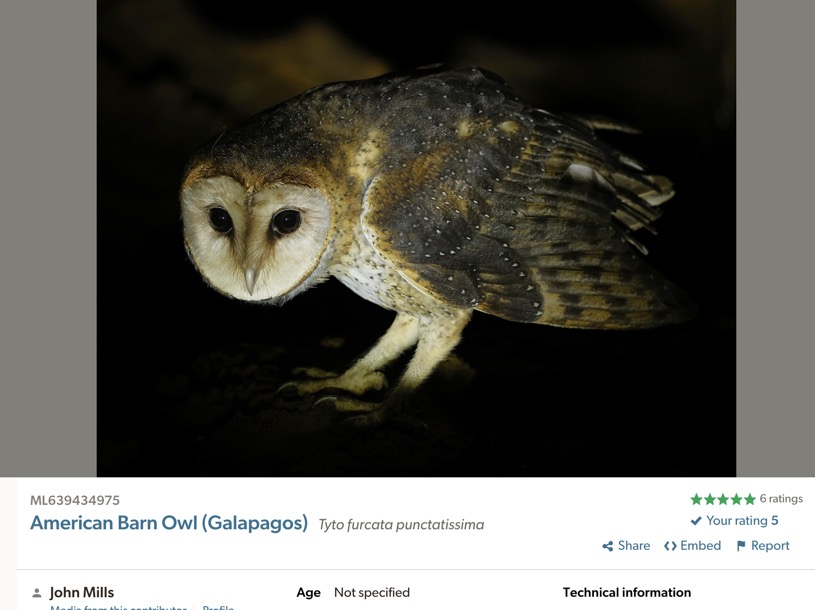
M.
Hulme’s plate from HBW:
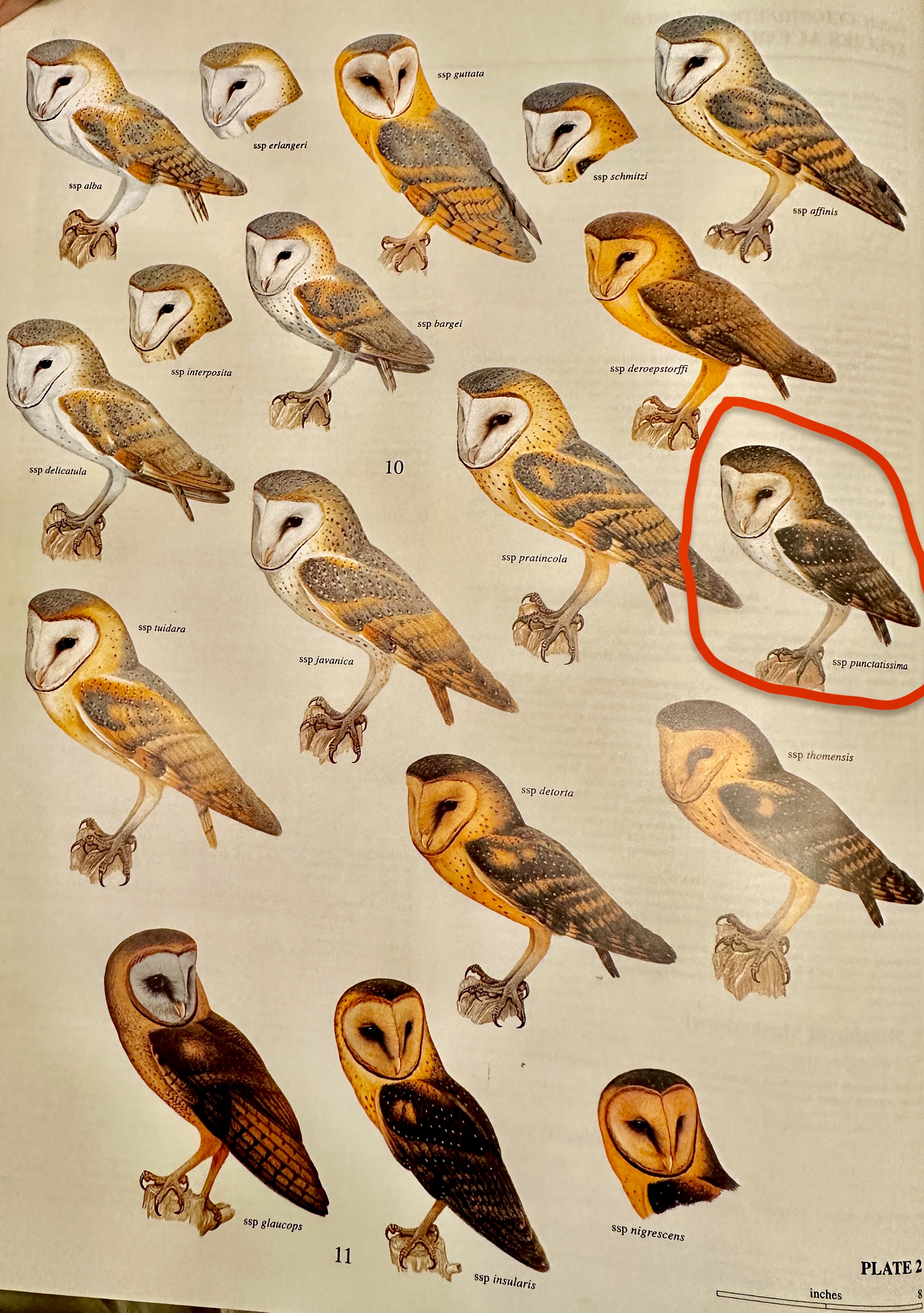
The
current SACC note is as follows:
1c. The endemic Galapagos
subspecies punctatissima was formerly treated as a separate species
(e.g., Ridgway 1914, Cory 1919), but Peters
(1940) treated it as a subspecies of widespread Tyto alba, and that
classification was followed in most subsequent classifications (e.g., Bruce
1999, König et al. 1999, Dickinson and Remsen 2013, del Hoyo and Collar
2014). However, Sibley & Monroe
(1990) and Bruce (1999) suggested that might deserve recognition as a separate
species from Tyto alba (now T. furcata), and
it was treated that way by Weick (2006), König & Weick (2008), and Wink et al. (2008).
Uva et al. (2018) found that it might be the sister taxon to Hispaniolan
T. glaucops. Proposal badly needed.
All
that Weick (2006) said was “Well marked, endemic island bird, suggest
separation as species!” König & Weick (2008) stated: “<<need help here – can someone
check>>”. Wink et al.
(2008) simply followed König & Weick’s classification without comment and
did not include punctatissima in their analyses.
New
information:
Uva et al. (2018), based on 5 mitochondrial and 2 nuclear markers, found that punctatissima
might be the sister to Caribbean T. glaucops:

However,
they were cautious in interpretation of this result:
“In the American Barn Owl, T. furcata, we found no differentiation
between North, Central and South America. Phylogeographic structure was only
detected between a clade of two insular taxa, T. g. glaucops from
Hispaniola and T. f. punctatissima from the Galapagos Islands, which
were sister to the remaining continental and insular American Barn Owls. The
extreme disjunct distribution of these sister taxa is even more surprising than
those of masked owl endemics from islands east and west of New Guinea, and given
the poor node support (0.77 PP/66 BS) putative genetic distinctiveness of
Caribbean and Pacific populations needs further confirmation from future
phylogeographic studies.”
Through
the grapevine, I have heard that punctatissima has a distinctive voice.
Macaulay has recordings of three individuals and xeno-canto, one. All four sound similar: a short, abrupt call
that might be homologous to the flight call of Tyto furcata, but
higher-pitched. All four Galapagos
recordings sound similar. Here’s the
best of the four recording, by Andres Trujillo Pakisusu:
•
https://xeno-canto.org/557834
Here’s
what I suspect is the homologous call from mainland Ecuador, by José María
Loaiza B.:
•
https://xeno-canto.org/947416
Discussion
and recommendation: The differences are suggestive but not impressive in my
opinion, and on their own fall short of evidence for species rank. What is
needed is an in depth exploration and quantitative, published analysis of the
repertoires. Through the grapevine, I’ve heard strong support for species rank,
so I must be missing something. Perhaps in Robb et al.’s “Sound Approach …” ?
(I cannot find the LSUMNS generously donated copy.)
English
names:
If anyone is opposed to Galapagos Barn Owl, the obvious name and one already in
at least informal use, please say do and agree to author a separate proposal.
References:
De Groot, R. S. 1983.
Origin, status and ecology of the owls in Galapagos. Ardea 71: 167-182
Wagner, H., and P. M.
Piedrahita. 2022. A comparison of aerodynamic
parameters in two subspecies of the American Barn Owl (Tyto furcata). Animals 12: 2532.
https://doi.org/10.3390/ani12192532
Van Remsen,
July 2026
_________________________________________________________________________________________________
Vote tracking chart:
https://www.museum.lsu.edu/~Remsen/SACCPropChart1044+.htm
Comments from Bonaccorso: “NO. Rigorous genetic and vocal sampling to
complement the morphological evidence is needed before making such a major
change. This is one I wouldn’t like to get wrong, since reverting to subspecies
status would be very controversial if we made the wrong decision.”