Proposal (1085) to South
American Classification Committee
Treat Cercomacra
cinerascens as consisting of five species, including two newly described
Background: The current
SACC footnote below sums up the history, and this proposal is to adopt the new
species limits in the complex proposed by Cavarzere et al. (2026).
39d. The subspecies sclateri
was formerly (e.g., Cory & Hellmayr 1924) treated as a separate species
from Cercomacra cinerascens, but they were
treated as conspecific by Peters (1951). Zimmer & Isler (2003)
suggested that Cercomacra cinerascens may consist of more than one
species. Cavarzere et al. (2026)
elevated two subspecies to species rank (sclateri, iterata) and
described two more species in the complex, Cercomacra mura and Cercomacra
raucisona. SACC proposal badly needed.
The
most recent classifications (Zimmer and Isler 2003 and 2020 HBW, Dickinson and
Christidis 2014) recognize four subspecies with ranges delimited by rivers in a
single pan-Amazonian species:
C. c.
cinerascens (north
of the Amazon from Ecuador and Peru to sw. Venezuela and nw. Brazil)
C. c. immaculata
(north
of the Amazon from se. Venezuela and central Brazil east through the Guianas)
C. c. sclateri (mostly south
of the Amazon in Peru and Bolivia east to the R. Madeira in sw. Brazil)
C. c. iterata (south of the
Amazon from the R. Madeira east to Maranhão in Brazil; also in ne. Santa Cruz,
Bolivia)
Zimmer
and Isler (2003) stated: “Races sclateri
and iterata suggested as perhaps representing a separate species from
nominate and immaculata, but vocal differences, if they exist at all,
seem to be very slight.” Note that at this
point, Zimmer and Isler were likely listening to the south bank population,
named below as mura, that was then included in sclateri.
Cory
and Hellmayr (1924) could not distinguish immaculata from cinerascens
and treated it as a synonym. They
treated sclateri as a separate species from cinerascens based on plumage
features; iterata was not yet described. Zimmer (1932) treated sclateri
as a subspecies of C. cinerascens and described iterata as
follows:
“Similar to C. c. sclateri of Peru south of the Amazon, but
males usually paler gray, especially below. Females like those of sclateri but
somewhat paler above and below and with the uropygium of the same olivaceous
brown color as the mantle, not grayish; under wing-coverts more purely white;
tail with a little more olivaceous tone, strongest on the lateral margins, and
with a more pronounced blackish area subterminally (in ventral aspects more
sharply contrasting with the main portion of the feathers).”
Zimmer
(1932) recognized immaculata, with the following rationale:
“A few females from Faro, Rio Jamundá, Brazil, and one of the same sex
from British Guiana agree with iterata in the possession of an olive brown
rump, thereby differing from cinerascens exactly as iterata differs from
sclateri. On the other hand they differ from iterata exactly as cinerascens
differs from sclateri, by the merely casual, instead of pronounced,
development of white on the upper wing-coverts. For these northeastern skins
there is an available name in immaculata Chubb, based on birds from
British Guiana. This form, I think, may be recognized on the characters
mentioned herewith. The white patch on the mantle reaches its minimum
development also in immaculata but, as pointed by Hellmayr (Field Mus.
Nat. Hist. Publ., Zool. Ser., XIII, pt. 3, p. 214, footnote a, 1924), this
character is variable.”
New
information:
Cavarzere et al. (2026) performed a comprehensive analysis of plumage,
morphometric, and vocal variation in the group using 682 specimens and 347
recordings (!). Their sampling was structured into 5 units as follows: “Based on our previous understanding of vocal
variation within C. cinerascens populations, we identified five
potentially separate lineages for all subsequent analyses: the northern C.
c. cinerascens (including C. c. immaculata) found north of the
Amazon River; and four southern populations: C. c. sclateri (east of the
Andes extending to the Ucayali River), the Ucayali-Madeira interfluve
population, the Madeira-Tapajos interfluve population, and C. c. iterata
(east of the Tapajos River)”. I’m
not sure why immaculata was not still included as a separate population
for analyses if only to see if diagnosable based on the plumage characters used
to describe it and those mentioned by Zimmer – see further comments below. Further, as noted by Cavarzere et al., Naka
(2012) found a 1.5% mtDNA sequence difference between cinerascens and immaculata
populations across the Rio Branco, so I would have definitely presented a
quantitative analysis of color characters before dismissing immaculata,
and see below under Genetic Data for additional data on the relative genetic
distinctiveness of immaculata.
Here
is the map of their samples:
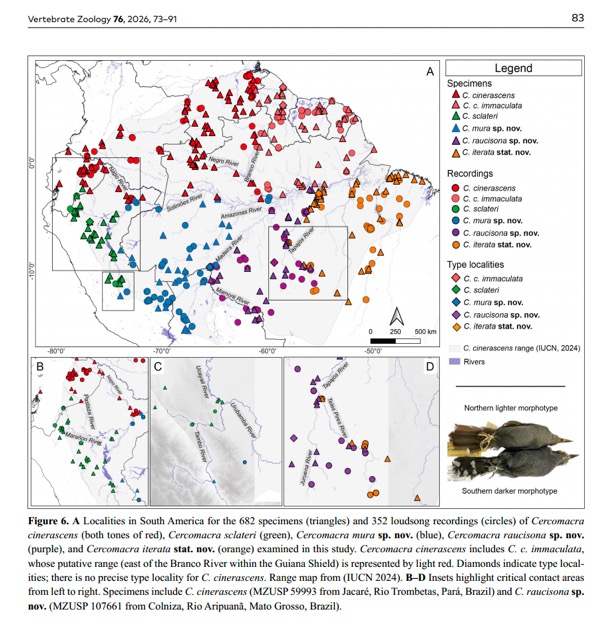
MORPHOMETRICS
A
typical suite of 9 measurements was taken from each skin, and although there
were statistically significant differences among the populations, none was
diagnostic and thus of no direct use in taxonomy. North bank cinerascens is the most
distinctive of the five, but it still overlaps heavily with the other four –
see their Figure 5.
PLUMAGE
Color
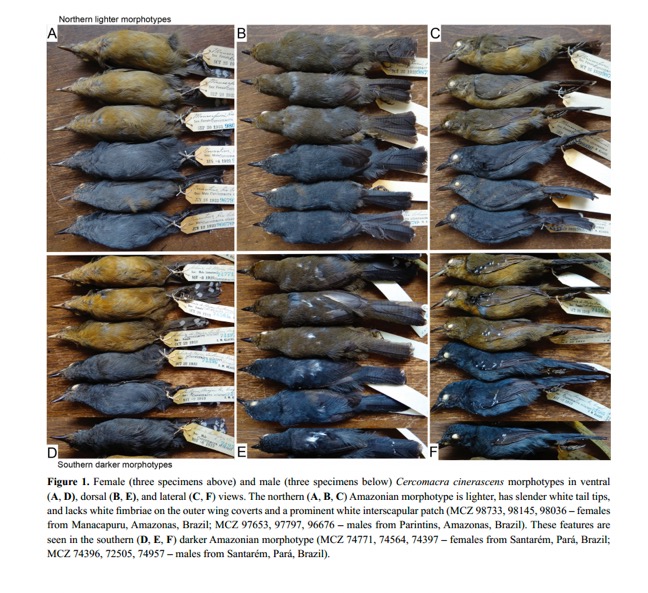
was assessed using the Munsell catalog for 23 body regions. Two general categories were diagnosable
separated by the Amazon drainage (starting with the Pastaza) for both males and
females; these corresponded to nominate cinerascens plus immaculata on the
north bank and everything else on the south bank. Here is their Figure 1
showing the two plumage groups:
However,
unless I’m missing something, they were unable to diagnose immaculata
from cinerascens, or iterata from sclateri, or the two
additional interfluve units from each other or sclateri or iterata,
although no such analysis is presented. Given
that both immaculata and iterata were described on the basis of
color patterns, the absence of direct discussion on this is confusing, beyond a
statement in the Introduction that they are “practically indistinguishable morphologically”. In the
formal taxonomic revision and discussion of each taxon, with diagnoses, color
is not mentioned other than separating cinerascens from all the south
bank taxa.
VOCALIZATIONS
Cavarzere
et al. analyzed 347 recordings quantified about 15 parameters – see their
Methods for details. In addition, they
used BIRDNET: “To supplement
manual measurements and capture subtle multidimensional acoustic variation, we
extracted 1024-dimensional feature embeddings from audio recordings using the
BirdNET algorithm, a deep neural network (DNN) based on a 157-layer Residual
Network (ResNet) architecture with 27 million parameters trained on millions of
globally distributed bird vocalizations (Kahl et al. 2021; McGinn et al. 2023).” Don’t ask me
to explain these analyses.
They
found that that sclateri and the Madeira-Tapajos populations (named
herein raucisona) occupy tight clusters of multivariate space, distant
from the other three – see their Figure 3 below. In contrast, south bank iterata is
completely enclosed within the space occupied by north bank cinerascens. Further, together they are not cleanly
separated from the Ucayali-Madeira population (herein name mura) , which
is also the most variable of all 5 samples, and one cinerascens song
falls withing the 95% confidence zone of the Ucayali-Madeira. LDA 1 is heavily
weighted by “proportions of types
of notes and note duration”.
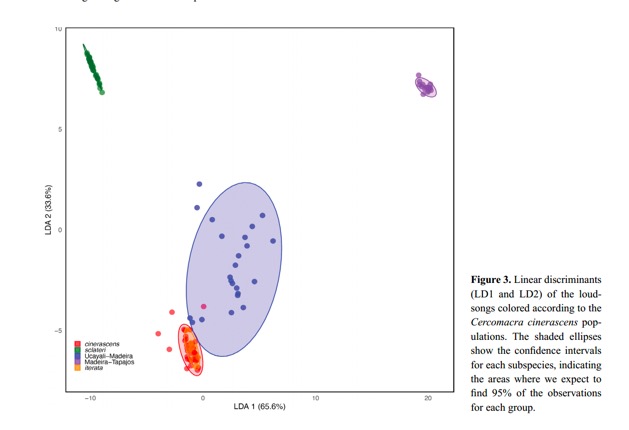
Note
that sclateri and raucisona are widely separated from each other
on LDA 1 but overlap completely on LDA 2, which from listening to the
recordings is likely heavily influenced by raspiness or “froggy-ness”. Note
also that although cinerascens and iterata are on opposite banks
of the Amazon and have different plumage patterns, but that they are adjacent
populations. In contrast, note that mura
is adjacent to sclateri and raucisona and share the south bank
plumage pattern, vocally it is close to and slightly overlapping with cinerascens+iterata. Thus, plumage and voice are not concordant,
at least at this scale.
Cavarzere
et al. performed visual inspections of sonograms but could only identify four
separate patterns; iterata was the one that they could not distinguish
visually. Here are the four:
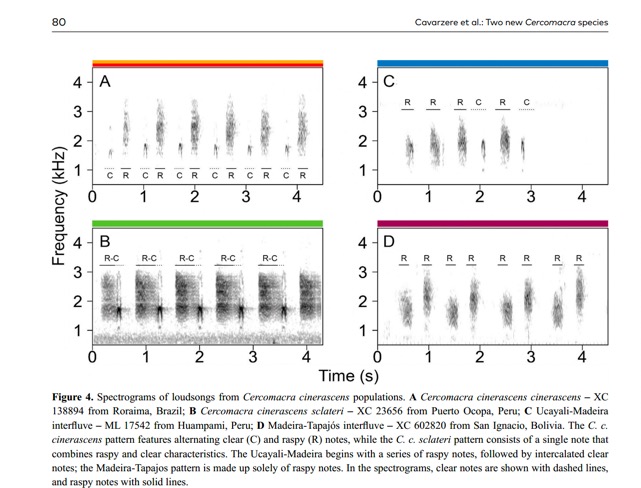
Examples
using their proposed taxonomy and Fig. 6:
C.
cinerascens:
•
https://xeno-canto.org/258453 (by John V.
Moore from Ecuador):
•
https://xeno-canto.org/81769 (by Andrew
Spencer from Vaupes)
C.
c. “immaculata”
•
https://xeno-canto.org/272080 (by Peter
Boesman from Suriname)
•
https://xeno-canto.org/925622 (By Gabriel
Leite from Amapá)
C.
iterata:
•
https://xeno-canto.org/258453 (by Peter
Boesman from Pará)
•
https://xeno-canto.org/599036 (by Gabriel
Leite from Pará
C.
sclateri:
•
https://xeno-canto.org/89097 (by Jeremy
Minns from Acre)
•
https://xeno-canto.org/23656 (by
Barros/Schmitt from Loreto)
C.
mura:
•
https://xeno-canto.org/2689 (by Sjoerd
Mayer from Beni)
•
https://xeno-canto.org/438450 (by Jerome
Fischer from rio Javarí, Amazonas, Brazil)
C. raucisona:
•
https://xeno-canto.org/108101 (by Tayler Brooks from Mato Grosso)
•
https://xeno-canto.org/89098 (by Jeremy
Minns from Borba, Amazonas, Brazil
No
playback trials were performed, and these would be of interest to me,
especially mura vs. cinerascens-iterata to see if those
differences matter to the birds.
GENETICS
Although
Cavarzere et al. did not do any genetic sampling, Harvey et al. (2020) included
5 individuals in their suboscine phylogenetic tree. Consulting their supplementary material
indicates that two were nominate cinerascens (1 from N of the Amazon in Loreto,
1 from Rio Negro, Amazonas), 1 was immaculata (Roraima, east of Rio
Branco), 1 was mura (Pando), and 1 was raucisona (Rôndonia east of R. Madeira). So, unfortunately, no sample from the critical
taxa iterata or sclateri. The
major split, as expected, is between the 3 north bank and 2 south bank
samples. Important to note is that the
single sample of immaculata is more divergent from the other two samples
of cinerascens than is mura from raucisona. Below is the critical section of the tree,
and the taxa from top to bottom are mura, raucisona, immaculata,
nominate cinerascens from R. Negro, and nominate cinerascens from
Loreto. The node where the north and
south bank clusters split is roughly 3 MYA (early Pliocene).

TAXONOMY
Cavarzere
et al. provided a very useful, detailed taxonomic revision, including even
synonymies (although I would say that inclusion of immaculata as a
synonym of cinerascens is premature based on points made above). In fact, I recommend checking this out the
details and format of the revision, and using it as a model for taxonomic
revisions. Their diagnoses for the five taxa
ranked as species are as follows:
• C.
cinerascens:
“Diagnosis. The taxon is
diagnosable by its light gray males (gray N/5) and olive yellow females (olive
yellow 2.5 Y 6/8). They lack (or they are reduced) wide fimbriae and white tail
tips; the interscapular patch is very reduced or missing, and the under-wing
coverts are the same color as the belly (gray N/5) (Fig. S6). These features
are combined with a loudsong which is a disyllabic series of repeated and
intercalated clear and raspy notes, similar to that of C. iterata stat.
nov.”
• C. iterata: “Diagnosis. Identified as the southern
Amazonian light gray morphotype with a loudsong typically consisting of
compound disyllabic phrases with intercalated clear and raspy notes, similar to
C. cinerascens’ loudsong.”
• C.
sclateri: “Diagnosis. The
distinctive loudsong of this taxon consists of raspy-clear one-note phrases,
which does not overlap in note duration, pace or the proportion of raspy notes with
the other four species.”
• C. mura sp.
nov.: “Diagnosis. The taxon is
identified by a loudsong consisting of phrases that begin with consecutive
raspy notes. A single recording (3% of the total) lacked this diagnostic trait
but still falls within our ≥95% diagnosability criterion.”
• C.
raucisona sp. nov.: “Diagnosis.
The taxon is identified by the unique disyllabic phrases with exclusively raspy
notes, distinguishing this loudsong from the other four species, with no
overlapping ranges of the number and proportion of raspy notes.”
Discussion
and recommendation:
At
the outset, l emphasize that the biology in this paper is illuminating and
valuable. It’s the doomed attempt to
force these situations into simplistic Linnaean taxonomy that creates the
problem. Even a fantastic data set may
be difficult to interpret in terms of our categorical taxonomy. So, kudos to the authors for assembling a
major data-set independent of whether I, SACC, or anyone concurs with their
proposed taxonomy. We’re going to get an
increasing number of similar cases for Amazonian birds, the interfluvial
distribution of which produces a more or less circular, “pie slices” array of
populations in various degrees of contact and isolated for various times. So, from the beginning, one could predict a messy
situation for taxonomy with inequal rates of character evolution. We’ve already bumped up against this with Schiffornis,
Rhynchocyclus, and others, and more are on their way.
With
that preamble, this is indeed a tough one.
Conflict between the two character sets (plumage and voice), and the
absence of complete genetic data tempts me to recommend sticking with the
status quo until this is all sorted out.
On the other hand, sclateri and raucisona seem so
different vocally from the other three that sticking with the status quo will
be masking, at least temporarily, differences in voice that we would normally
recognize at the species level. This is
of course biologically interesting but taxonomically frustrating.
The
biggest problem in terms of taxonomy is what to do with iterata. Based on plumage it fits in the south bank
group but is vocally indistinguishable from the north bank population, so it
would be hard to justify calling a separate species from cinerascens
using our usual framework for species limits in the Thamnophilidae. As for mura, it is diagnosable only by
song, and even in terms of song it is very close to north bank cinerascens
rather than the two taxa that bracket it geographically, sclateri and raucisona.
Furthermore, there are no plumage or morphometric characters that can
distinguish any of the south bank populations from each other as far as I can
tell.
In
summary, we have a clean and abrupt difference in plumage between north and
south bank populations, but this conflicts with the vocal differentiation, with
one of the south bank populations identical to the north bank populations,
another different but still fairly similar to the north bank population, and
two remaining, disjunct south bank populations with songs so different from
north bank populations, and to some degree to each other, that I think that the
usual reaction would be along the lines of “must be different species.”
So,
my take on the history of the group (with the caveat that I may be
misinterpreting some results) is that proto-cinerascens was widely
distributed around the Amazon and fractured into 5 (or 6 depending on further
work on immaculata) Amazonian “pie slices”. North and south bank
populations diverged in plumage. Cinerascens
+ immaculata likely represent the ancestral song type, which was
retained by iterata, and diverged only slightly in mura. Songs of sclateri and raucisona
diverged from the ancestral song but sort-of the same direction in becoming
raspier. Cool stuff but not easily
reflected in traditional binomial and even trinomial taxonomy. I think Cavarzere et al. could be used as a
textbook example of the stochastic component in divergence and the consequent
inability of traditional taxonomy to capture this.
Voting
procedure:
This one is tough to design for the obvious reason that anything between
recognizing all 5 or retaining the original single species taxonomy requires
decisions on which taxa are included within which species. Let’s see how the
following voting scheme works, with each option a YES/NO vote.
A. One species.
Continue to treat C. cinerascens as a single species pending additional
data, e.g., genetic analyses. This one
acknowledges that there are more than likely two or more additional species,
but more complete genetic data are required for assigning subspecies to
species.
B. Five species. Accept Cavarzere et al.’s species limits as is,
i.e.. 5 species.
C. Two species based on
the two general color patterns, i.e. north bank C. cinerascens as one
species and all south bank taxa as another species, C. sclateri (as in
Cory & Hellmayr 1924).
D. Two species based on
the extreme visual differences in the sonograms (B vs A-C-D). This would mean
treating sclateri as a monotypic species, with all the more “normal”
sounding taxa, i.e. the other south bank taxa, included in polytypic cinerascens.
E. Three species based
on the multivariate distribution of vocal characters in Figure 3 above, i.e. sclateri
and raucisona treated as separate species, and the third being cinerascens+iterata+mura.
F. Four species: as in
E above but separate mura as a species from cinerascens+iterata
based on the centroids in Figure 3.
I
think these are the defensible taxonomic interpretations of the data presented,
but if you see others, speak out so I can add them to the list. I haven’t
decided whether the vote should be limited to a single YES and all the others
NO, or to allow for more than one YES to allow for multiple acceptable
solutions. The answer to that will
likely unfold during voting.
English
names:
Here’s what Cavarzere et al. recommended:
C.
cinerascens:
Northern Gray Antbird
C.
sclateri:
One-note Gray Antbird
C.
mura:
Mura Gray Antbird
C.
raucisona:
Raspy-voiced Gray Antbird
C.
iterata:
Southeastern Gray Antbird
Cory
and Hellmayr (1924) called C. sclateri “Sclater’s Antbird”.
I
suggest we defer this to a separate proposal once we see how the taxonomic
proposal fares.
References:
Cavarzere,
V., Breviglieri, E. L., & Silveira, L. F. 2026. Integrative taxonomy of the Cercomacra
cinerascens species complex with description of two new species (Aves:
Thamnophilidae). Vertebrate Zoology 76:
73-91.
HARVEY, M. G.,
G. A. BRAVO, S. CLARAMUNT, A. M CUERVO, G. E. DERRYBERRY, J. BATTILANA, G. F.
SEEHOLZER, J. S. MCKAY, B. C. O’MEARA, B. G. FAIRCLOTH, S. V. EDWARDS, J.
PÉREZ-EMÁN, R. G. MOYLE, F. H. SHEDLON, A. ALEIXO, B. T. SMITH, R. T. CHESSER,
L. F. SILVEIRA, J. CRACRAFT, R. T. BRUMFIELD, AND E. P. DERRYBERRY. 2020. The
evolution of a tropical biodiversity hotspot.
Science 370: 1343-1348.
Naka,
L. N., Bechtoldt, C. L., Henriques, L. M. P., & Brumfield, R. T. 2012. The
role of physical barriers in the location of avian suture zones in the Guiana
Shield, northern Amazonia. American Naturalist 179(4), E115-E132.
Van Remsen,
July 2026
_________________________________________________________________________________________________
Vote tracking chart:
https://www.museum.lsu.edu/~Remsen/SACCPropChart1044+.htm