Proposal (1086) to South
American Classification Committee
Modify species limits
in Ramphotrigon megacephalum
Background: The current
SACC footnote below sums up the slim history, and this proposal is to treat Ramphotrigon
megacephalum as two species as proposed by Lavinia et al. (2020).
142c. Ridgely & Tudor (1994)
noted differences in vocalizations between nominate megacephalum from
the Atlantic forest and populations from western Amazonia. Lavinia et
al. (2019, 2020) found evidence that suggests that Ramphotrigon megacephalum
consists of at least two species. SACC proposal badly needed.
Ridgely
& Tudor stated: “In Peru and
Ecuador this [call] is an even, fairly fast ‘whoo-whoo’, whereas in se. Brazil
it is a somewhat burrier (especially first note) ‘wheeu … whoo’, typically with
a long interval, often several seconds or more, between notes.”
I
cannot find any previous explicit suggestion that more than one species is
involved in this polytypic species. The
most recent classifications (e.g., Dickinson and Christidis 2014) recognize
four subspecies:
R. m. pectorale
Zimmer
and Phelps, 1947 (north of the Amazon from se. Colombia, e. Ecuador, and ne. Peru
to sw. Venezuela and nw. Brazil)
R. m.
venezuelense Phelps
and Gilliard, 1941 (north of the Amazon from se. Venezuela and central Brazil
east through the Guianas)
R. m. bolivianum
Zimmer,
1939 (mostly south of the Amazon in Peru and Bolivia east to the R. Madeira in
sw. Brazil)
R. m. megacephalum
(se.
Brazil, ne. Argentina, extreme e. Paraguay)
The
four subspecies differ primarily in differences in color intensity on back,
breast, and belly (HBW). Tidbit: when
Zimmer described bolivianum in 1939, he had only three specimens, from
one locality in Bolivia; evidently, no specimens were known (or recognized?)
from Peru, Ecuador, Colombia, or Venezuela at that time.
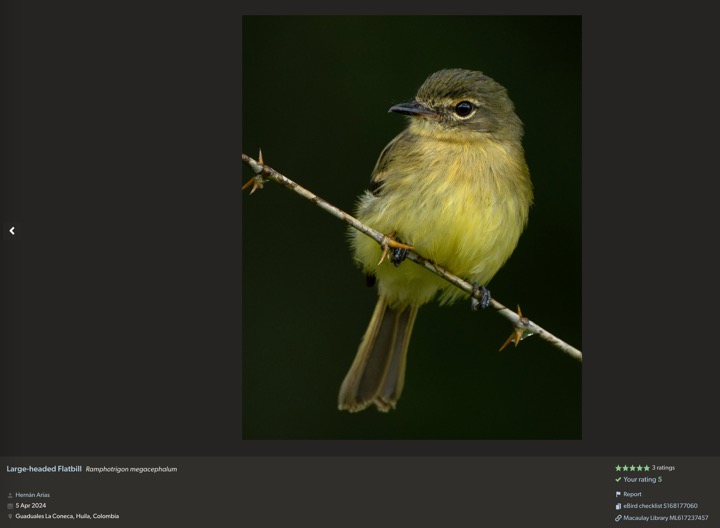
R.
m. pectorale
from Huila by Hernán Arias:
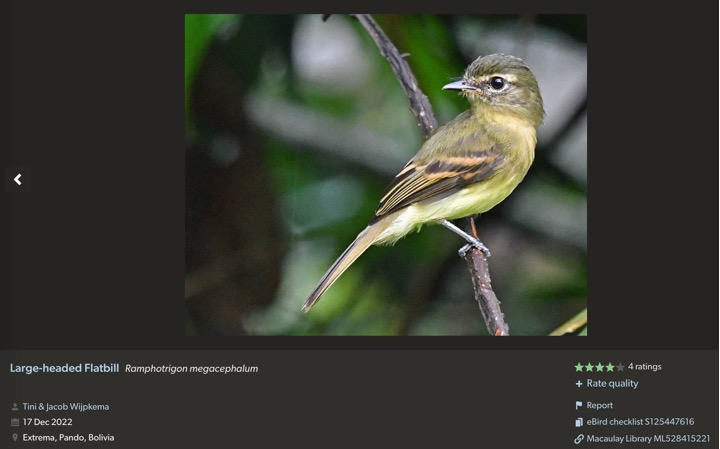
R.
m. bolivianum from Pando by Rini and Jacob Wijpkema
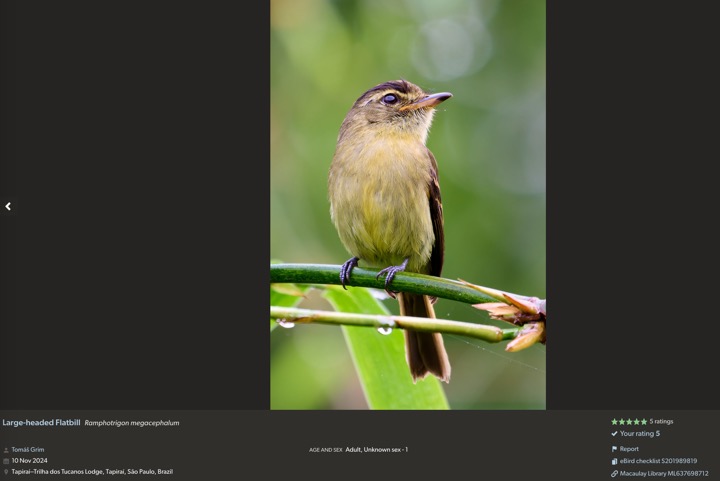
R.
m. megacephalum from São Paulo by Tomás Grim:
New
information:
VOCALIZATIONS
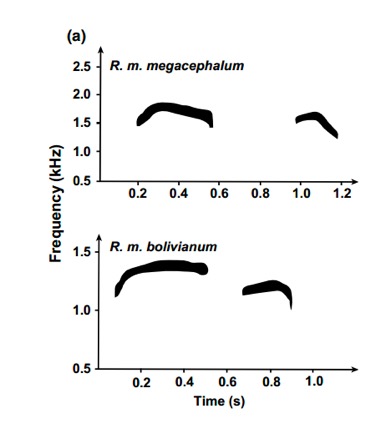
Lavinia
et al. (2019) quantified 12 parameters from the primary vocalizations using
recordings of 22 bolivianum and 17 nominate subspecies (SI Table s6), and found
statistically significant differences in all 12 parameters, but more
importantly, little or no overlap in several parameters, e.g. bandwidth of the
song (the “burriness” referred to by Ridgely & Tudor above), and minimum
and maximum frequencies of the first note. The stylized spectrogram they presented (see
below) shows some of these differences as well as the longer inter-note
interval mentioned by Ridgely & Tudor for Atlantic forest birds (although
not the same degree of note separation). Note the frequency difference between the two is
not particularly evident until you compare axes:
Sample
recordings:
•
R. m. bolivianum:
https://xeno-canto.org/37962 (from Mato
Grosso by Andrew Spencer)
https://xeno-canto.org/1068542 (from Madre de
Dios by Frank Lambert)
and
a nice video with song by Tomaz Melo from Acre:
https://media.ebird.org/catalog?birdOnly=true&taxonCode=lahfla2&sort=rating_rank_desc
•
R. m. megacephalum:
https://xeno-canto.org/415583 (from Paraná
by Jayrson Araujo de Oliveira)
https://xeno-canto.org/334798 (from São
Paulo by Jerome Fischer)
No
playback trials were performed.
I
also did a little digging on my own based on the mention that nominate megacephalum
might not have a longer dawn song, as was known for birds from western Amazonia
and found that it has what I am interpreting as a dawn song [see correction
from Andrew Spencer in Comments]; more importantly, the presumed dawn songs [see
correction from Andrew Spencer in Comments] of the two also differ
substantially:
•
R. m. bolivianum:
https://xeno-canto.org/47935 (from Mato
Grosso by Andrew Spencer)
•
R. m. megacephalum:
https://xeno-canto.org/82383 (from São
Paulo by Jeremy Minns)
GENETICS
Lavinia
et al. (2019) sampled 35 specimens, all of nominate megacephalum or bolivianum,
to generate sequence data for three mitochondrial genes (cyt-b, COI, ND2)
and one nuclear intron (FIB5); the results of the latter are shown below.
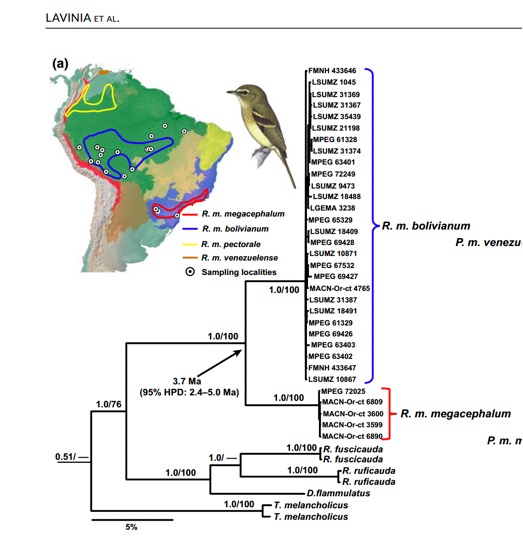
Fig. 2 from
Lavinia et al. 2019. Bayesian majority rule consensus mt DNA gene trees of Ramphotrigon
megacephalum
In
their study of the relationships among Ramphotrigon and Deltarhynchus,
Lavinia et al. (2020) sampled some of the same individuals of the two
subspecies of R. megacephalum and unsurprisingly found strong divergence
between the two populations and estimated the divergence time at about 3 MYA.
Harvey
et al. (2020) included single individuals from western Amazonian (Ucayali) and
the Atlantic Forest (Santa Catarina). Just eyeballing the tree, the depth of
the node that joins them is comparable to species-level node depths for several
related tyrannids in that clade.
TAXONOMY
Although
Lavinia et al. (2019, 2020) treated bolivianum as a subspecies, they
recommended it be treated a species.
Discussion
and recommendation:
This
one seems to me to be a straightforward split even if based only on voice, and
so I recommend a YES to a two-way species split.
The
genetics are consistent with a two-species treatment, and the depth of the node
that joins nominate and bolivianum is reasonably similar to that
associated with species differences, although I would not use that as the sole
basis for species rank.
The
main question would be what to do with genetically unsampled pectorale
and venezuelense.
Based
on checking a few recordings (with all appropriate caveats), I think it is safe
to include venezuelense as a subspecies of bolivianum based on
primary call/song, which to my ear sound “identical). Here are some samples:
•
venezuelense
https://xeno-canto.org/272184 (from Suriname
by Peter Boesman)
https://xeno-canto.org/209926 (from Suriname
by Peter Boesman)
I’m
not so sure about the intervening subspecies pectorale from eastern
Ecuador and Colombia). Here are some
examples, which differ to my ear in the second note being the same of higher
pitched than the first, i.e. opposite of bolivianum and venezuelense:
•
pectorale:
https://xeno-canto.org/1073681 (from Napo by
Juan Freile)
https://xeno-canto.org/688357 (from Caquetá
by Mauricio Cuellar Ramirez)
https://xeno-canto.org/258812 (from Napo by
John V. Moore)
Suspicious! Perhaps just a quirk of small N or something
real? Ridgely & Greenfield Birds of
Ecuador described the voice as the having the second note lower in pitch, i.e.,
just like bolivianum, so something is weird. Something to be investigated, at
least. Regardless, I think the only
option is to include pectorale in bolivianum based on the general
tone of the vocalization.
English
names:
I
suggest we defer this to a separate proposal once we see how the taxonomic
proposal fares, but please be mulling over the possibilities. Amazon Large-headed and Atlantic Large-headed
are two obvious choices. Western and Eastern could also be used. Neither pair is inspired, but I don’t see a
lot of colorful possibilities out there for two species that do not differ much
in plumage, and whose vocal differences are not easily translated to simple
English words. I think “High
Large-headed Flatbill” might make a Jimmy Fallon monologue, however.
References:
HARVEY, M. G., G. A. BRAVO, S. CLARAMUNT, A. M
CUERVO, G. E. DERRYBERRY, J. BATTILANA, G. F. SEEHOLZER, J. S. MCKAY, B. C.
O’MEARA, B. G. FAIRCLOTH, S. V. EDWARDS, J. PÉREZ-EMÁN, R. G. MOYLE, F. H.
SHEDLON, A. ALEIXO, B. T. SMITH, R. T. CHESSER, L. F. SILVEIRA, J. CRACRAFT, R.
T. BRUMFIELD, AND E. P. DERRYBERRY.
2020. The evolution of a tropical
biodiversity hotspot. Science 370:
1343-1348.
LAVINIA, P. D., A. S. BARREIRA,
L. CAMPAGNA, P. L. TUBARO, AND D. A. LIJTMAER.
2019. Contrasting evolutionary
histories in Neotropical birds: divergence across an environmental barrier in
South America. Molecular Ecology 28: 1730–1747.
LAVINIA, P. D., P. ESCALANTE, P.
L. TUBARO, , AND D. J. LIJTMAER.
2020. Molecular phylogenetics and
phenotypic reassessment of the Ramphotrigon flycatchers: deep paraphyly
in the context of an intriguing biogeographic scenario. Journal of Avian Biology 51(4).
Van Remsen,
July 2026
_________________________________________________________________________________________________
Vote tracking chart:
https://www.museum.lsu.edu/~Remsen/SACCPropChart1044+.htm
Comments
from Andrew Spencer: “I was very happy to see this proposal come up, since it reminded me of
vocal variation that I had noticed in the past, but am embarrassed to admit I
had completely forgotten about. I'm much more familiar with the voices of the
Amazonian taxa than I am with the Atlantic one, but the differences between
them do seem consistent and (in my opinion), species-level. After reading this
proposal, I went into a bit of a Ramphotrigon rabbit hole, and believe
the vocalizations can be divided into a few different categories.
The most important of these is
what I think of as the "day song", the common, two note phrase that I
first learned as "bam-boo", and is forever cemented in my mind
for the species. Both Amazonian and Atlantic taxa have a two note day song, but
it's when you dig further that the interesting differences come to
light. The most striking of these is what Van summarized above, the pitch
and spacing differences between the first and second note.
“But as I looked through a number
of recordings on the Macaulay Library, I realized it's not quite that simple.
It appears that day songs are made up of particular notes, for which I'll
borrow terminology mostly used when discussing Empidonax vocalizations:
an "A" phrase, and a "B" phrase. By far the most commonly
delivered variation is these two notes given together, in an AB...AB...AB...
etc pattern, hence the "bam-boo...bam-boo..." etc song.
However, it is also not uncommon for just the A phrase to be given by both
forms (e.g. in https://macaulaylibrary.org/asset/623416870 for Amazonian, and https://macaulaylibrary.org/asset/657136419 for Atlantic), or for a mixed delivery (e.g. in https://macaulaylibrary.org/asset/147945 for Amazonian, and https://macaulaylibrary.org/asset/658454475 for Atlantic).
“Where this becomes interesting is
that it appears that Atlantic birds, and so far as I can tell, only \ Atlantic
birds, also have a "C" phrase. This is also regularly given in
isolation (e.g. https://macaulaylibrary.org/asset/656864316), and in series of just A and C phrases (e.g. https://macaulaylibrary.org/asset/609169290), and in bouts where it or the A phrase are combined with the B phrase,
with delivery something like CB...CB...CB...AB...CB...A...CB...AB...etc
(see https://macaulaylibrary.org/asset/22176 for that specific example).
“It does appear that recordings
with all three phrases like this are a distinct minority on ML, but they are
common enough, and geographically widespread enough in the broader range of
nominate megacephalum, that I am comfortable saying it's a feature
of the subspecies. For the Amazonian taxa, I did notice there is quite a bit of
minor variation in the A phrase, and also in the spacing, but that this
variation seems to be on a very local level and possibly just individual
variation. From Mato Grosso for example, there are some songs with noticeably
kinked A phrases (e.g. https://macaulaylibrary.org/asset/110006), but also those with what I consider more normal A phrases (e.g. https://macaulaylibrary.org/asset/309963). I think this type of variation accounts for what Van was seeing in
recordings from Ecuador when compared to those from elsewhere in the Amazon.
“I've made a quick and dirty
graphic of day songs from both Amazonian and Atlantic birds, roughly ordered
from north to south, shown below. Amazonian is on the left, Atlantic on the
right; for Atlantic recordings where there were both AB and CB phrases in the
same recording, I included both on the same line, divided by a blue bar. For
the Amazonian taxa, the locations are: northern Venezuela, Meta (Colombia),
Ecuador, Madre de Dios (Peru, 2x), Pando (Bolivia), Mato Grosso (BR), Para
(BR), Guyana, and Suriname. For the Atlantic side, the ordering is Espiritu
Santo, Rio de Janeiro, Sao Paolo (x2), Santa Catarina (x2, AB from one
individual, CB from another), Parana, and Misiones (Argentina). The examples,
especially from the Amazon, were selected to highlight some of the individual
variation in A phrases.
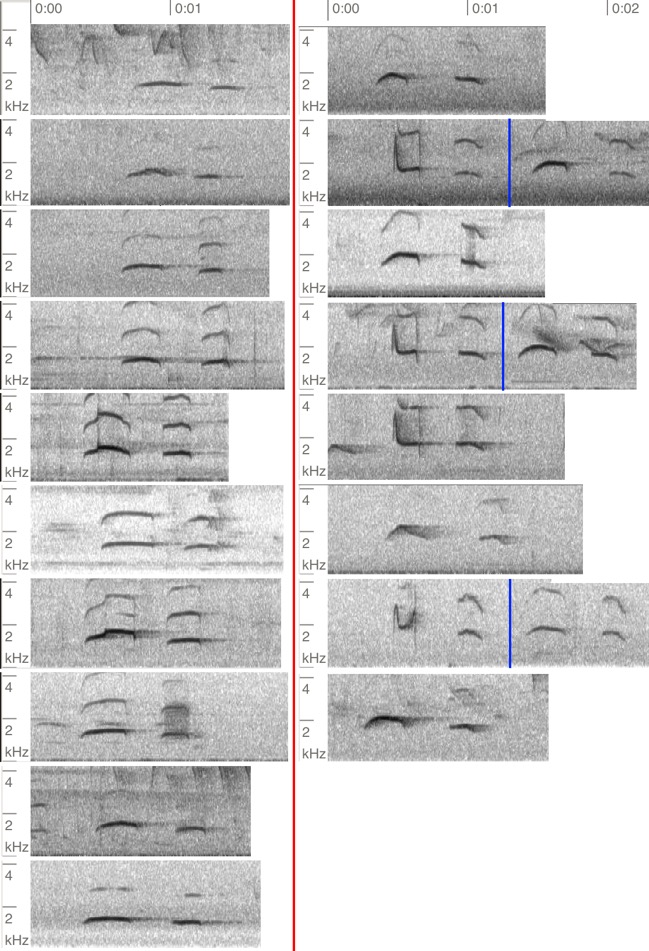
“Finally, my impression as I was
going through recordings was that the Atlantic forms give series of just A or C
phrases more commonly than Amazonian ones given those of just A phrases, but I
didn't keep count so that may not be accurate.
“The other main sound heard from
these birds, at least Amazonian ones, is dawn song. This has long been one of
my favorite vocalizations not because it's spectacular, but because on some of
my earliest outings in the Amazon I would hear an unknown song from bamboo
patches while it was still almost pitch black. At first I thought it was some
weird nightjar that I could never match to recordings of any expected species,
and could never find no matter how hard I tried with spotlights or playback.
And I can still remember well the eureka moment when I figured out what was
making that sound. In the Amazonian forms there are a number of recordings
available (https://macaulaylibrary.org/asset/135174 or https://macaulaylibrary.org/asset/35141 for example), and the vocalization appears relatively stereotyped in
every recording I can find.
“For the Atlantic forms there is far
less to go on; in ML the only one tagged as dawn song is this one by Ted Parker
(https://macaulaylibrary.org/asset/30144). It's much simpler than recordings from the Amazon, but does have
unique notes and phrasing as compared to both day songs and the dawn song of
the Amazonian birds. I haven't gone through every single recording in ML
looking for another example, but I have at least glanced over most of them and
have not seen another cut of it. It is either much more rarely given than the
dawn song in the Amazon, or (perhaps more likely?), recordists just haven't
been in place during the brief window the song is delivered.
“I've made another comparison
illustration of dawn songs, shown below, with bolivianum on left,
nominate megacephalum on right..
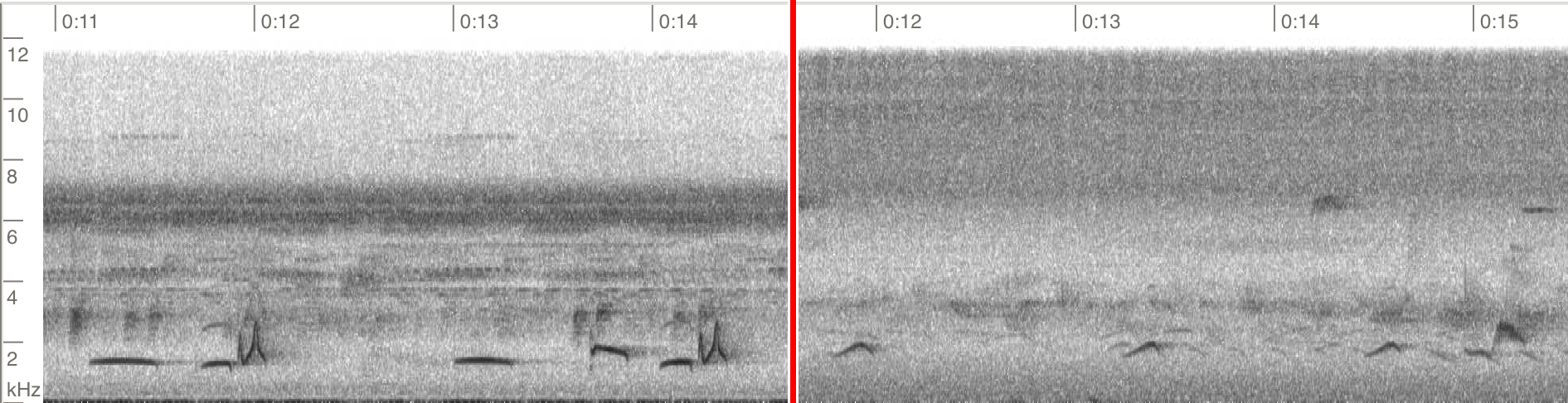
“Finally, I can't resist a chance
to get a quick word on common names in. I've always disliked the name
"Large-headed Flatbill" - the head really isn't that large when
compared to other Ramphotrigon. I'd advocate for using Ridgely's
"Bamboo Flatbill", maybe with "Amazonian" and
"Atlantic" as modifiers. I know that R. fuscicauda is also a
bamboo specialist, although maybe not so much as megacephalum. And I
know that megacephalum is not strictly a bamboo species absolutely
everywhere it occurs. But as has been said ad nauseum, common names don't need
to be perfect. They can just be better than "Large-headed"!
Comments from Areta: “YES. Vocal, genetic, and to
some extent also plumage and bill aspect data, support the existence of at
least two species in R. megacephalum. Given
the lack of vocal analyses and genetic samples of northern subspecies pectorale and venezuelense in
the bolivianum group, I was worried. After
listening to a random sample of recordings, I can sign in to split bolivianum, including pectorale
and venezuelense. Although formal studies
would be welcome to further strengthen this view, the vocal evidence indicates
that these three subspecies belong to the same species, R.
bolivianum. I’d like to note that the “third” note type that Andrew
suggested was exclusive of megacephalum,
occurs also in the bolivianum group (taxon venezuelense: https://macaulaylibrary.org/asset/298174011).”