Proposal (1088) to South
American Classification Committee
Treat Phaethornis b.
major as a separate species from P. bourcieri
Background: Phaethornis
bourcieri (Straight-billed Hermit) is widely distributed in Amazonia. It had been treated as a polytypic until Hinkelmann
(1989) first showed that the subspecies whitelyi (of the Guianan Shield,
as one might predict from the eponym) was not diagnosable. But Hinkelmann also studied the poorly known
south bank population in eastern Brazil, and found it to be diagnosable; he described
this population as a new subspecies, P. b. major, based on major size
differences (hence the species epithet).
Although he could find only two specimens, their size difference was so
great that he felt comfortable in describing it as a new taxon; their wing and
tail lengths were roughly 5 mm longer than typical birds. He could find no plumage differences between major
and other populations. This classification was followed by Schuchmann in HBW,
Dickinson and Remsen (2013), and others.
P. b. bourcieri (Lesson,
1832): north of the Amazon from se. Colombia, Ecuador, and ne. Peru east
through the Guianan Shield region, and south of the Amazon in e. Peru, extreme
w. Brazil, and Pando (Bolivia).
P. b. major Hinkelmann,
1989: south of the Amazon in Pará along the Rio Tapajós.
Note
that the gap between in the range south of the Amazon is filled by Phaethornis
philippii.
New
information:
GENETICS
Araújo-Silva
et al. (2017) sequenced 2600+ base pairs of mtDNA (ND2, cytb) nDNA (BF5) from 41
specimens of P. b. bourcieri and 13 from P. b. major (as well as
other Phaethornis spp., including the third straight-billed Phaethornis,
P. koepckeae).
Here
are the results expressed as a tree:
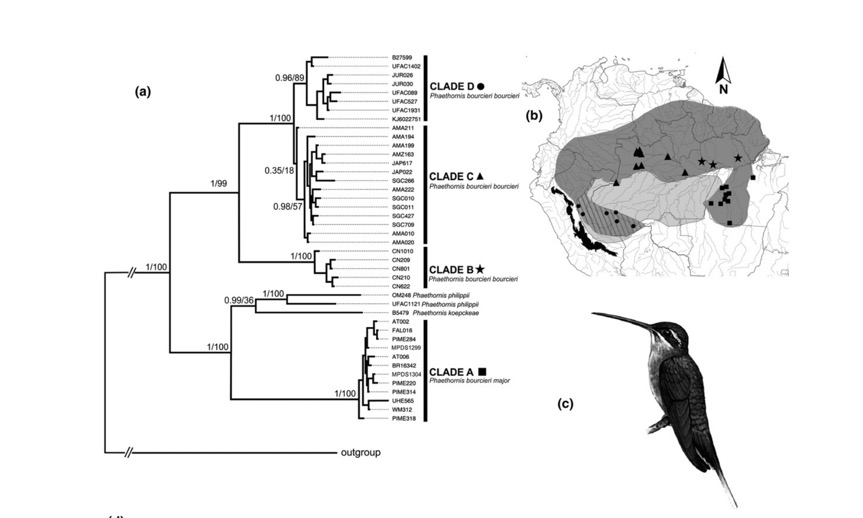
Thus,
major clusters with philippii and koepckeae with strong support,
not with P. b. bourcieri. A
perhaps even more astounding result in that within P. bourcieri,
Clade B (the Guianan Shield population) is as diverged from D and C as major
is from philippii and koepckeae.
The oldest node in the tree is estimated at 3.1 to 4.4 MYA.
PLUMAGE
and BARE PARTS
Araújo-Silva
et al. (2017) cited Vitor Piacentini’s unpublished dissertation (2011) for
additional information on phenotypic characters of major. Perhaps Vitor will elaborate. Hinkelmann had only two specimens of major
when he described it, but Piacentini had access to additional (and new?)
specimens. From Araújo-Silva et al.
(2017):
“Clade A birds (P. b. major) have much lighter grey bellies than
those in clades B, C and D, in addition to bolder gular and malar stripes and
reddish rather than yellowish mandibles (Piacentini 2011, L.E. Araujo-Silva and
A. Aleixo pers. obs.). Therefore, a
heavily marked throat and red mandible are shared by P. b. major and P.
philippii plus P. koepckeae, mirroring phylogenetic relationships
recovered for these taxa.”
So,
now the genetic results make more sense in the light of the new phenotypic
information – very exciting! And the gray rather than tawny underparts shared
by major and bourcieri is attributable to something besides a
sister relationship.
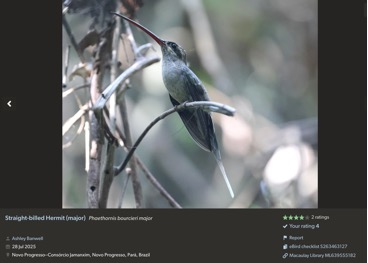
Macaulay
has only 7 photos of 3 individuals of major, but they are all
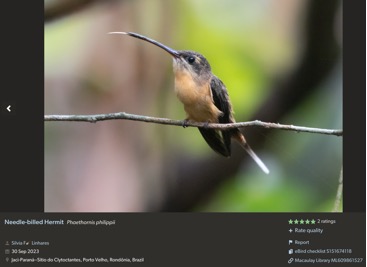
useful. Here’s one, along with photos of
three other taxa in the analyses:


VOCALIZATIONS
Araújo-Silva
et al. (2017) alluded to some vocal differences among bourcieri clades
found by Piacentini (2011 dissertation), but we can let Vitor elaborate. I listened to a few recordings of the taxa
and populations in Macaulay and xeno-canto, and I quickly that no conclusions
could be drawn from superficial dabbling, especially with the tiny amount of
material available for major.
TAXONOMY
Araújo-Silva
et al. (2017) proposed species rank for P. m. major based on their gene
trees that were concordant with phenotypic characters found by Vitor and
Hinkelmann.
They
also proposed that the three clades within proper P. bourcieri should be
recognized as species but discussed why it would be premature to name these
taxa without more data and analyses. A
complicating factor is that the type specimen of bourcieri not only is
lost but the type locality is “Brazil”, hence useless at this point.
Discussion
and recommendation: I am tempted to recommend a YES on this one based on the
rationale by the authors, especially because the west to east sequence south of
the Amazon of koepckeae-philippii-major as a group has
some intuitive biogeographical appeal.
On the other hand, I worry that the relationships shown by the mtDNA
gene trees might not reflect true phylogeny, and without elaboration on the
phenotypic characters, I feel uneasy. If
those of you willing to dive into the genetic analyses can assure me that the
results are not just incomplete lineage sorting or investigate the actual data
to see if a BF5 tree would be consistent with the mtDNA tree, then I will feel
more certain
English
names:
I recommend a separate proposal on this if the split passes. Tapajos Hermit would be an obvious candidate,
but that name is taken by P. aethopygus. Hinkelmann’s Hermit has a nice
ring to it, too. Hinkelmann published a
number of important papers on Phaethornis and was the one who
“discovered” the taxon.
References:
ARAÚJO-SILVA, L. E., L. S. MIRANDA,L. CARNEIRO, AND & A. ALEIXO. 2017.
Phylogeography and diversification of an Amazonian understorey
hummingbird: paraphyly and evidence for widespread cryptic speciation in the
Plio-Pleistocene. Ibis 159: 778–791.
Hinkelmann, C. 1989. Notes on the taxonomy and geographic variation
of Phaethornis bourcieri (Aves: Trochilidae) with the description of a
new subspecies. Bonn. zool. Beitr 40: 99-107.
Van Remsen,
July 2026
________________________________________________________________________________________________________________
Vote tracking chart:
https://www.museum.lsu.edu/~Remsen/SACCPropChart1044+.htm
Comments from Areta: “YES. Split! The phylogenetic relationships, depth
of divergence and phenotypic distinctions all point to the same direction, and
recognizing Phaethornis major
is the logical conclusion. The sorting of the remaining populations of P. bourcieri to either other species level or
subspecies level taxa will have to await deeper studies. At present, the
nomenclatural aspects need attention (especially, to which population would the
name bourcieri strictly apply) and further
sampling, coupled to vocal and formal morphological analyses are needed,
especially in the light of lack of distinctiveness uncovered by Vitor,
seemingly contradicting none other than the great John T. Zimmer.
“To answer Van’s point,
the dataset is not purely mitochondrial. The supplementary material shows
consistent nuclear (BF5) and mitochondrial (CytB and ND2) phylogenetic trees:
https://onlinelibrary.wiley.com/action/downloadSupplement?doi=10.1111/ibi.12500&file=ibi12500-sup-0001-Supinfo.docx. Also, the sister
relationship between major and philippii-koepckeae
was recovered by McGuire et al. (2014).”
Comments
from Zimmer: “YES, to splitting, and treating major
as a species distinct from the rest of P. bourcieri. The phylogenetic data would certainly seem to
point to this conclusion, both in terms of the depth of the divergence
indicated in the tree branches, and, in terms of major clustering with
the other South Bank taxa (philippii and koepckeae) rather than
the other three clades of bourcieri.
A split is further supported on phenotypic grounds, in that major is
demonstrably larger in measurements, and in plumage characters. As regards phenotypic differences, I would
note that the Brazilian website/photo archive WikiAves has 29 photos of major
and many more of other bourcieri from other parts of Brazil (outside the
range of major), and although the noted plumage distinctions seem to hold up,
the distinctiveness of mandible color does not.
All of the photos of major that I examined appear to show a red
base to the lower mandible, but photos of bourcieri from various N Bank
locations (Manacaparu, Manaus, Amapá) included individuals
with a yellow base to the lower mandible as well as individuals with a red base
to the lower mandible, with both mandible colors being represented from the
same localities. Plumage differences,
particularly the color of the underparts, appeared to be much more consistent. I would agree that further splitting of bourcieri
(apart from recognizing major as distinct), although suggested by the
phylogenetic data, is premature without further analysis, especially given
concerns over lack of corresponding phenotypic differentiation, as well as
nomenclatural concerns regarding the missing holotype and the ambiguous nature
of the described type locality.”