Proposal (1092) to South
American Classification Committee
Treat Chiloe Steamer
Duck Tachyeres ketru as species distinct from Magellanic Steamer Duck Tachyeres
pteneres
Effect
on SACC list
If
this proposal passes, it will result in the recognition of Chiloe Steamer Duck Tachyeres
ketru as a species distinct from Magellanic Steamer Duck Tachyeres
pteneres.
Background
The current SACC note reads: López-Lanús & Costa (2026) described a
new species of Tachyeres, T. ketru, for the northern population
of T. pteneres. SACC proposal badly needed.
Since
the first decade of the 21st century several experts in the field have
discussed a distinct form of T. pteneres from the Chiloe/Aysén region of
Chile, which has also been widely described in scientific databases as a
distinct “undescribed form” or “likely a different species.” The taxon has long
been well known to be distinguishable by coloration of the bill.
New
Information
López-Lanús
& Costa (2026) describe a new taxon from the Chiloe/Aysén region of Chile
on the basis of significant differences in ecology, vocalizations, and the
coloration and sexual dichromatism of bare parts.
Ecology
López-Lanús
& Costa (2026) described ecological differences between the northern and
southern populations of T. pteneres in detail. The Taitao Peninsula,
located at roughly 46° south, serves as the main barrier between the proposed T.
ketru in the north and T. pteneres in the south. The peninsula also
divides different ecoregions comprising substantially different coastal
conditions which are reflected in the habitat preferences of the two
populations. While both species are strongly tied to the presence of the macroalgae
Macrocystis pyrifera, T. ketru occurs in more sheltered waterways
north of Taitao, which align with the presence of a “protected coastal ecotype”
of M. pyrifera. South of the peninsula, T. pteneres inhabits more
exposed shorelines that experience powerful ocean wave action and cold currents
and are associated with a different, morphologically distinct ecotype of M.
pyrifera.
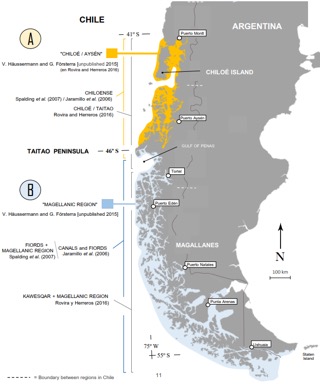
A
map of the study area and ecoregions associated with P. ketru and P.
pteneres, from López-Lanús & Costa (2026), summarizing descriptions
from Jaramillo et al. (2006), Spalding et al. (2007), V. Häussermann and G.
Försterra [unpublished 2015] in Rovira and Herreros (2016) and Rovira and
Herreros (2016).
Vocalizations
López-Lanús
& Costa (2026) found that all Tachyeres taxa, including the proposed
T. ketru, can be segregated consistently on the basis of the contact
calls made by males. This call type is shown to be homologous between all taxa
in the genus, and each taxon has a distinct and consistent frequency range and
frequency distribution that allows for reliable identification based on visual
inspection of spectrograms. The authors also note that T. pteneres and T.
ketru can be distinguished auditorily by observers. The authors found that
the frequency distributions of contact vocalizations of T. pteneres south
of the Taitao are more similar to those of T. leucocephalus of Argentina
than they are to those of the proposed T. ketru. Additionally, the
frequency distributions of contact calls of T. ketru are more similar to
those of T. patachonicus than they are to those of T. pteneres.
Playback experiments do not appear to be applicable because the birds were not
observed to respond territorially to auditory stimuli without visual cues
(López-Lanús & Costa, 2026).
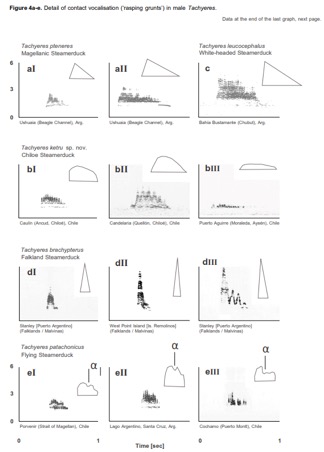
From
López-Lanús & Costa (2026), detail of individual contact calls from males
of all Tachyeres taxa.
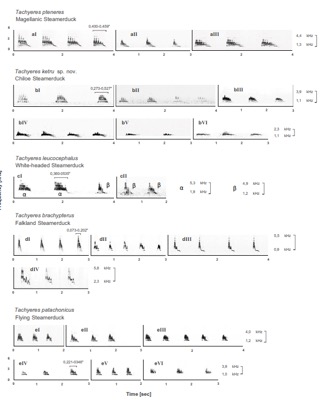
From
López-Lanús & Costa (2026), examples of note sequences from contact calls
of male Tachyeres.
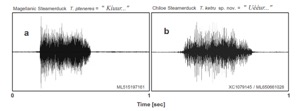
From
López-Lanús & Costa (2026), oscillograms representative of contact calls
from P. pteneres and P. ketru.
Coloration
and Sexual Dichromatism of Bare Parts
López-Lanús
& Costa (2026) showed that the proposed T. ketru can reliably be
distinguished from T. pteneres on the basis of coloration and sexual
dichromatism of bare parts in living individuals (although the distinguishing
pigmentation is not reliably preserved in museum specimens). They also
demonstrated that the distinguishing traits do not vary clinally across the
distribution of T. ketru or T. pteneres. Although diet, which may
vary between the two ecoregions inhabited by the two populations, can impact
the coloration of bare parts, the presence of the diagnostic greenish-gray
subnarial patch in T. ketru is shown to be independent of both the
intensity of yellow/orange pigmentation of the rest of the bill as well as the
season of observation. In addition to possessing a subnarial patch which
distinguishes them from T. pteneres, T. ketru also demonstrates
sexual dichromatism in the coloration of the bill, with females possessing a
much more pronounced subnarial patch than males. In contrast, sexual
dichromatism is not observed in the bill coloration of T. pteneres:
.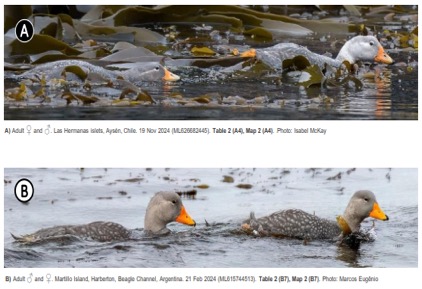
From
López-Lanús & Costa (2026), photos demonstrating typical bill pattern and
coloration in pairs of T. ketru and T. pteneres.
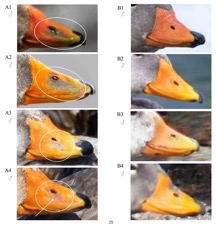
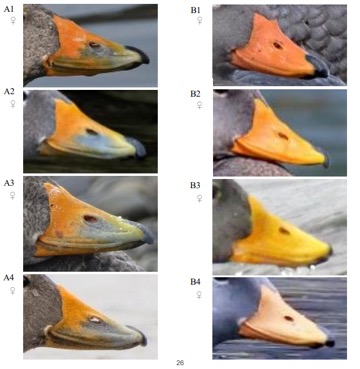
From
López-Lanús & Costa (2026), closeup images of bill patterning in male and
female T. ketru (A) and T. pteneres (B).
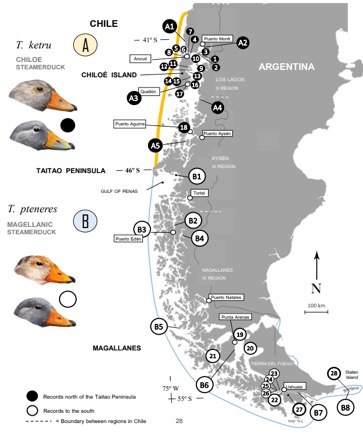
From
López-Lanús & Costa (2026), distribution of T. ketru and T.
pteneres. Numbers indicate localities of sound records included in their
analysis, while alphanumeric codes indicate relevant photographic specimens.
The authors remind readers to “Note the coincidence of the distributions of
both taxa with the ecoregions in the Study Area shown in Map 1 [included
above].”
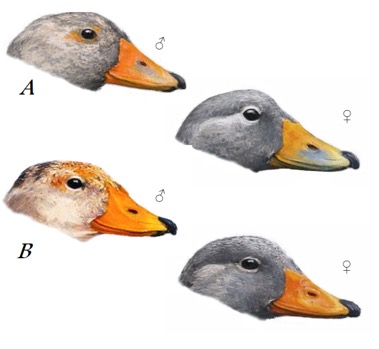
From
López-Lanús & Costa (2026), a summary painting of male and female of T.
ketru (A) and T. pteneres (B). Note subnarial patch present in both
male and female T. ketru, as well as sexual dichromatism of this field
mark in this species. T. pteneres does not display subnarial patch or
sexual dichromatism of the bill.
Additional
Comments
Genetic
data would greatly improve our understanding of the taxonomy of Tachyeres,
especially of the boundary between T. ketru and T. pteneres, but
substantial differences in ecology, vocalizations, and coloration and sexual
dichromatism of the bill seem to provide sufficient evidence to seriously
consider elevation to species status at this time.
Notes
on Nomenclature and Etymology
López-Lanús
& Costa (2026) suggest the name “Chiloe Steamerduck” for the new species,
but following the current standards used in AviList, and in alignment with an
ongoing trend of reducing hyphenation, the name would perhaps best be “Chiloe
Steamer Duck.”
The
specific epithet “ketru” proposed by López-Lanús & Costa (2026)
comes from the name for Tachyeres in the local indigenous Mapuche
language (Mapudungun), used especially for this taxon.
López-Lanús
& Costa (2026) provide extensive justification for the use of the epithet “ketru”
instead of “chiloensis” for the newly described taxon by demonstrating
the absence of the principle of priority. Although the epithet “chiloensis”
occurs in the 1782 and 1810 editions of Saggio sulla Storia Naturale del
Chili from J. I. Molina, the description provided in that text is
sufficiently unclear and self-contradictory as to not be reliably assignable to
any taxon when assessed with any scrutiny.
Additionally,
the recognition of T. ketru as a species distinct from T. pteneres
would invalidate the current neotype of T. pteneres. Because of the lack
of a specimen from the original description from the Strait of Magellan, a
neotype was selected, but an individual from the island of Chiloe was chosen
instead of one from the area of the original description, and is thus
representative of T. ketru and not of the intended T. pteneres.
The authors thus propose a holotype and new neotype for T. ketru and T.
pteneres respectively, both held at the American Museum of Natural History
in New York, USA. The proposed holotype of P. ketru is from Chiloe
Island, Chile, in 1914, whereas the new neotype proposed by the authors for P.
pteneres is from the Beagle Channel, Chile in 1915.
Voting
and Recommendations
Likely
best resolved with two votes:
A) Species
limits: We recommend a YES vote to recognize T. ketru as a species
distinct from T. pteneres.
B) English
names: We recommend a YES vote to adopt the name Chiloe Steamer Duck for T.
ketru and Magellanic Steamer Duck for T. pteneres. [Note from Remsen
– in SACC orthography, the group name is Steamer-Duck]
References
López-Lanús, B. and M.
Costa (2026). A new species of Steamerduck (Anatidae: Tachyeres) from
the Chiloé region, Chile, finally confirmed as a taxon distinct from Tachyeres
pteneres. The Audiornis Journal of Bioacoustics and Field Ornithology,
5:2-130. https://audiornis.org/journal/articulos/AUDIORNIS%20(2026)%20Number%2005%20February%20pp%201-130%20Tachyeres%20ketru%20SP%20NOV.pdf
eBird.org,
Flightless Steamer Duck, https://ebird.org/species/flistd1
Nick
Kowalske, October 2026
________________________________________________________________________________________________________________
Vote tracking chart:
https://www.museum.lsu.edu/~Remsen/SACCPropChart1044+.htm