Proposal (1068) to South
American Classification Committee
Establish English names for Turdus phaeopygus
and T. albicollis
With the passage of the SACC proposal 1047 on changes in
species limits in broadly defined Turdus albicollis, we need to
establish English names for newly recognized Turdus phaeopygus and more
narrowly defined T. albicollis.
(We already agreed to use Dagua Thrush for T. daguae.).
From Oscar Johnson and Jacob Cooper’s SACC
proposal 1047 we have the following:
“For T. phaeopygus
and T. albicollis, Clements/eBird uses Gray-flanked for phaeopygus
and Rufous-flanked for albicollis, which are acceptable and available
names. Other options could include retaining White-necked for albicollis
and adopting a new name for phaeopygus, but it is not clear what other
names might apply to that bird. Amazonian Thrush is an option, as the species
is widespread in the Amazon Basin, but it is one of many Amazonian Turdus
species. We encourage SACC members to discuss potential names for these taxa.”
I’ve tried to get someone else, anyone else
but me in fact, to work on this one, but no one stepped forward, so I’m going
to start by simply proposing we adopt the eBird names, both of which are
accurate. Yes, other South American Turdus
have gray flanks and rusty flanks, but you all know what we are up against with
the limited plumage variation is in these birds. Keeping the eBird group names is also a
positive. Keeping “gray” as part of the
name to match the “phaeo” part of the species
epithet will help people like me remember the new names.
Nonetheless, if any of you have inspired
names, speak up. Hellmayr and Cory
(1934) used Gray-rumped Thrush for the subspecies name of T. a. phaeopygus,
a direct translation of the species epithet.
The differences in the flank color are more conspicuous than those in
the rump, so I think the eBird name is better.
Here's a photo of T. phaeopygus:
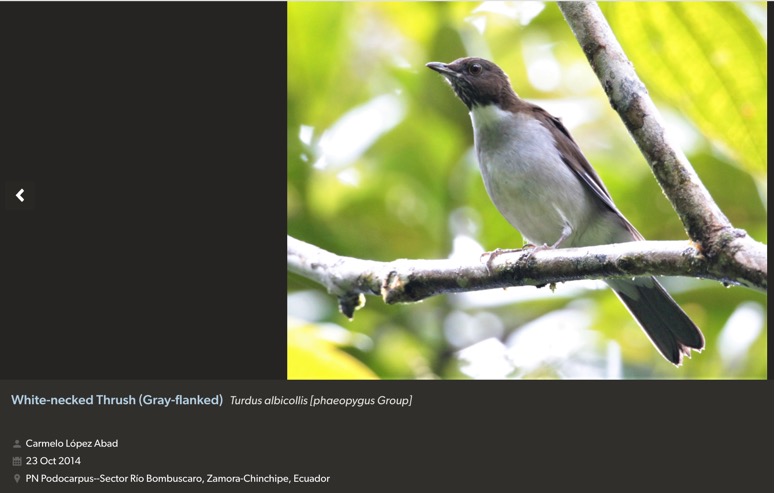
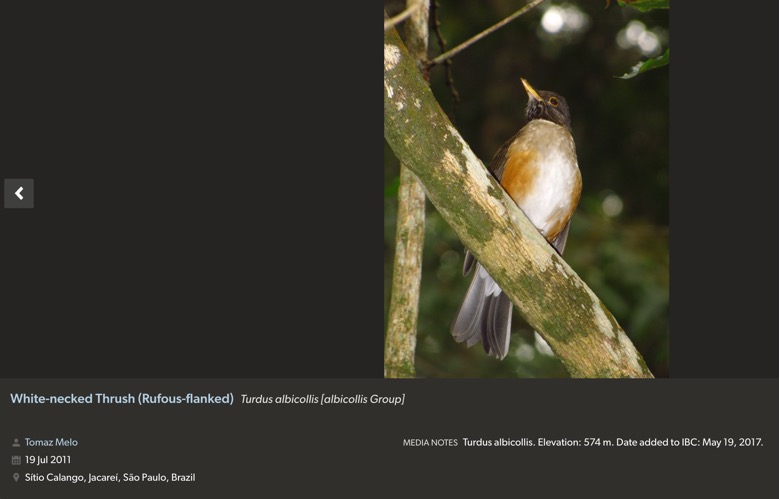
And here is one of Turdus albicollis
sensu stricto:
As noted by Oscar and Jacob, “Amazonian Thrush” is problematic,
and retaining White-necked Thrush for the narrowly defined daughter T.
albicollis goes against our guidelines
for names of parent-daughter splits.
So, I recommend a YES on this one pending creation of inspired
competitors by one of you or someone out there.
Van Remsen,
November 2025
Vote tracking chart:
https://www.museum.lsu.edu/~Remsen/SACCPropChart1044+.htm
Comments
from Gary Rosenberg (voting for Naka): “On
using Gray-flanked Thrush for Turdus phaeopygus and
Rufous-flanked Thrush for T. albicollis, I vote YES. Seems like obvious
choices to me - particularly since they are already adopted eBird. I agree that
using “flanked” is better than “rumped” as no one will ever see the rump of
this species.”
Comments from
Donsker (who has Bonaccorso vote): “YES. I would
strongly support the use of the English names Gray-flanked Thrush for T.
phaeopygus and Rufous-flanked Thrush for T. albicollis. The names are not only morphologically appropriate
but are also nicely complementary.
“In
addition to their use (and now widespread introduction) in eBird, both names
have historical precedence as well, having been used as suggested English names
for these two taxa at least as far back as in Sibley & Monroe (1990).”
Comments from Rasmussen (who
has Robbins vote): “YES. I agree with continuing the use of Gray-flanked
and Rufous-flanked Thrush, especially as it seems doubtful that better
names will be found for two more of the many not-especially-distinctively
marked Neotropical thrushes (not to mention those of the Old World!). These
names contrast well with each other and highlight the character most likely to
be visible and to enable identification.”
Comments from
Josh Beck (who has Claramunt vote): “I also vote YES for Rufous-flanked and Gray-flanked. Given
that these birds are frequently seen from below, that the names are actually
pretty good for ID, and that they have a track record already, this seems like
a non-controversial one.”
Comments from
Jacob Cooper (who has Remsen vote): “YES--as much as I am a fan of having concordance between
scientific and English names, Gray-flanked is much more useful for field
identification than Gray-rumped and contrasts nicely with Rufous-flanked. These
names are also fairly established thanks to eBird, so it is a straightforward
change of English names.”
Comments
from Mark Pearman: “I just looked at this for the first time today and was
immediately confused by which taxa would be included by each potential name.
The southernmost taxon in south-western S. America is contemptus,
which is resident in Yungas forest of Bolivia south to the Orense-Tucumano forest block of NW Argentina. This is part of the albicollis
clade (sensu Batista et al. 2020; SACC 1047) but has grey flanks. In
Misiones, NE Argentina and in E Paraguay, paraguayensis is also part of
the albicollis clade, and that has rufous flanks. There are a few
similar umbrella-patterned geographical ranges of species with east-west colour switches or variables in the same region and which
arc through Paraguay and Bolivia from NE to NW Argentina, so this is not
surprising to me. There was already confusion over the placement of contemptus in SACC 1047. Therefore, if contemptus is part of the albicollis clade,
then the names suggested will need a rethink. I raise this through my own
confusion over the issue.”
Response
from Remsen: “Mark
and I have been discussing this online.
Mark does indeed have a photo from Chuquisaca that shows no trace of
tawny flanks. Yet fulvous or tawny
flanks are part of the diagnosis of contemptus,
as in Hellmayr’s type description (type locality in Santa Cruz) , and photos
from La Paz and Santa Cruz have tawny/fulvous flanks (to be checked against
specimens soon). Perhaps there is an undescribed population at the southern end
of the contemptus group, but I would be
surprised that no one had noticed this from specimens. To be investigated …. Regardless, for the purposes of this
proposal, I think this should be set aside for now.”
Comments
from Zimmer:
“YES to using Rufous-flanked Thrush for T. albicollis, and for using
Gray-flanked Thrush for T. phaeopygus.
These names do, indeed, highlight the best plumage characters for
separating the two from one another, and flank color is also one of the better
characters (after the conspicuous white throat crescent) for distinguishing
both species from other sympatric Turdus species. The fact that the names are complementary,
and, already in prevailing usage in eBird, adds to their attractiveness.”
Comments
from Stiles:
“YES - these names,(Gray and Rufous, respectively) are apt and already in use.”
Comments
from Lane:
“YES to adopting the suggested names Rufous-flanked and Gray-flanked thrushes
for T. albicollis (with contemptus) and
T. phaeopygus (and associated taxa), respectively. At least the
populations of T. a. contemptus I know from
Bolivia and Peru have a rufous wash to the flanks, so I am not so concerned
about that name not being appropriate.”