Proposal (1087) to South
American Classification Committee
Treat Willisornis poecilinotus
as consisting of six species
Background: The current
SACC footnote is as follows
60. Pinto (1978) treated lepidonota
(with duidae) as a separate species from W. poecilinotus, and
Hilty (2003) and Zimmer & Isler (2003) suggested that more than one species
was involved; however, see Zimmer (1934d), Willis (1982), and Ridgely &
Tudor (1994). Isler & Whitney (2011)
presented evidence that the subspecies vidua
merits species rank (including also nigrigula). SACC proposal passed to treat vidua as separate species. Pulido-Santacruz et al. (2018) found strong
evidence for post-zygotic reproductive isolation between W. poecilinotus
and W. vidua in their headwaters contact zone and found strong evidence
for barriers to gene flow. Naka and
Brumfield (2018) and Silva et al. (2019) found that W. poecilinotus is a
paraphyletic species with respect to W. vidua. Quaresma et al. (2022) found that broadly
defined W. poecilinotus was paraphyletic with respect to W. vidua;
they recommended recognizing six species of Willisornis. SACC proposal needed.
The
subspecies are defined primarily on the basis of major differences in female
plumage, and subspecies distributions are mostly river-delimited. We have already separated W. vidua
from Willisornis poecilinotus, and there have been several
suggestions that multiple species are involved.
Isler and Whitney (2011) analyzed songs from throughout the Amazon Basin
and showed that those of vidua (with nigrigula) differ from those
of all other taxa to the degree associated with species limits in
antbirds. However, they emphasized that
gaps in their sampling, especially in headwater contact zones, left the status
of some taxa not fully resolved.
The
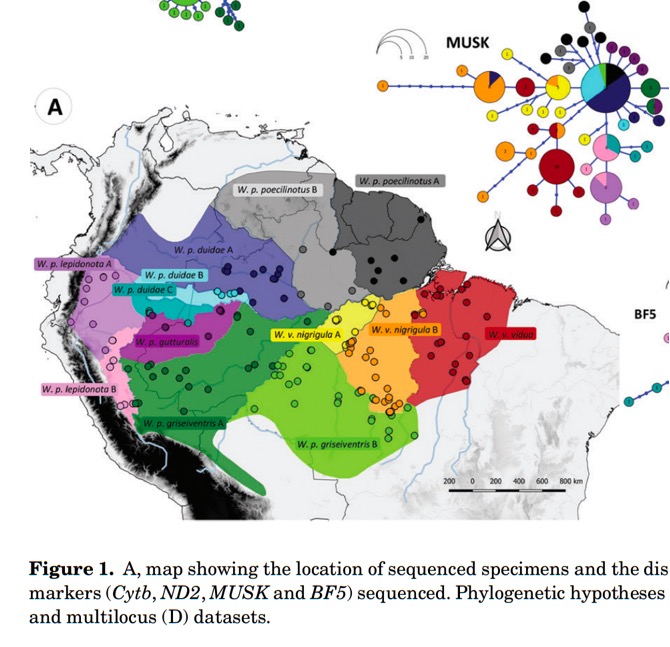
distribution of the subspecies is as follows (from Quaresma et al. 2022; note
that five of the seven subspecies were subdivided as separate sampling units).
New
information:
GENETICS
Pulido-Santacruz
et al. (2018) did a densely sampled transect (n=144) through the headwaters
region of the Teles Pires and Xingu rivers (along with another 70 individuals
from elsewhere in Amazonia) and found (using SNPs) that although W. p.
griseiventris and W. vidua showed no sign of assortative mating that
they also showed no signs of gene flow between them, i.e., evidence of almost
complete post-zygotic reproductive isolation.
This is the sort of result that those of us focused on mate choice and
assortative mating need to process in our thinking about the BSC. One interpretation is that natural selection
has not yet produced a prezygotic isolating mechanism despite vocal and female
plumage differences.
Naka
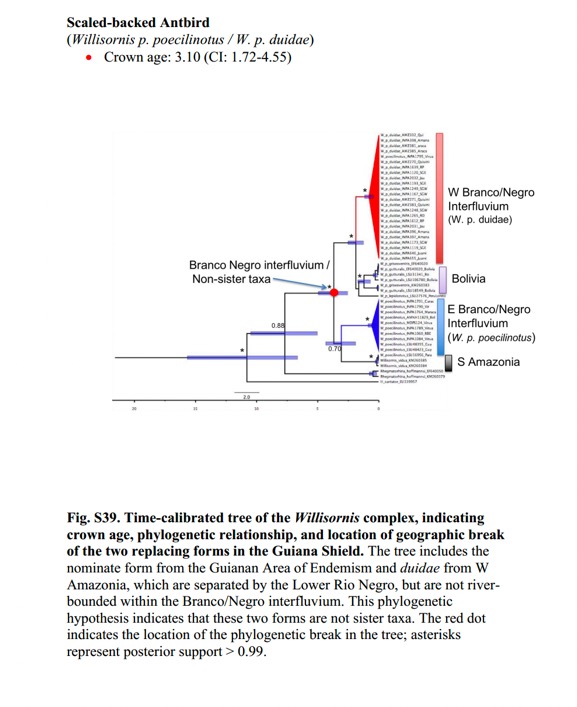
and Brumfield (2018; Fig. S39) used mtDNA sequence data in their broad study of
differentiation across the Rio Branco/Rio Negro region, and found the following
relationships, which showed that vidua (see “S Amazonia” section of the
tree) is embedded within poecilinota, although note the weak support for
the sister relationship of vidua and nominate poecilinotus.
Silva
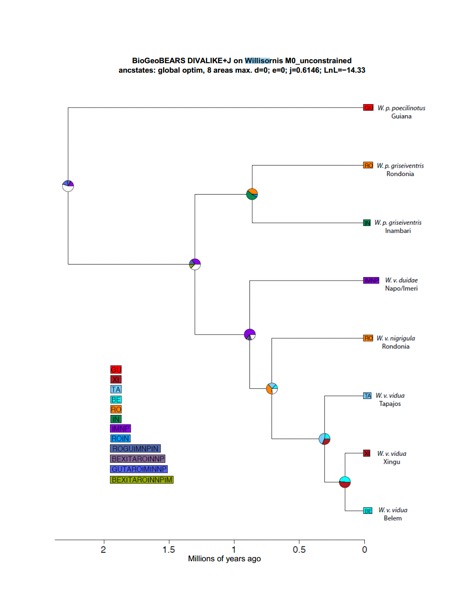
et al.’s (2019; Fig. S2 below) analysis of mtDNA and nDNA sequence data also showed
that W. poecilinotus as currently defined is paraphyletic, with the
southwestern Amazonian subspecies griseiventris closer to W. vidua
than either is to nominate poecilinotus from the Guianas.
Harvey
et al. (2020) included W. vidua and four samples of W. poecilinotus
in their genomic analysis. The taxa in their tree are as follows: LSU16954 is
from Pará (vidua); INPA “2032” (=2031) is from the Jaú, Amazonas, Brazil
(duidae); L55367 is from Suriname (nominate poecilinotus); LSU
8861 is from Pando (griseiventris), Bolivia; MCP 2362 is from Rôndonia (griseiventris).

Note
that this conflicts with the results from Naka and Brumfield and Silva et al.
in that vidua is sister to all other Willisornis, most
importantly including duidae. Therefore,
although individual and taxon sampling is much weaker in Harvey et al., the
much broader genetic sampling in Harvey et al. suggests that the results using
mtDNA in the other studies are driven by incomplete lineage sorting or
hybridization, and the case for using paraphyly as evidence for further species
splits is weakened.
Quaresma
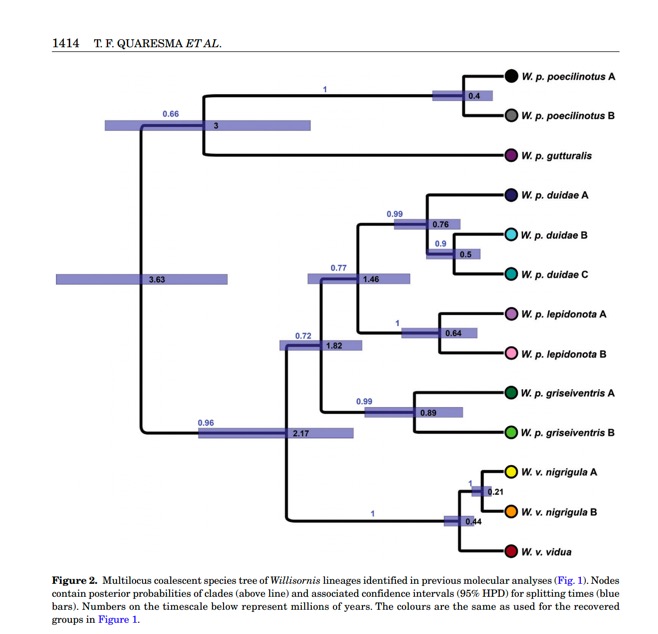
et al. (2022) performed the most comprehensive genetic study of Willisornis
with 182 samples from throughout the range of the genus – see their Fig. 1
above. Two mitochondrial (cytb, ND2) and two nuclear (BF5,
MUSK) genes were sequenced. They
identified 13 reciprocally monophyletic lineages, and the relationships among
them were as follows:
PLUMAGE
Quaresma
et al. assessed several aspects of male and female plumage of over 1000
specimens, and found that each taxon is diagnosable based on plumage, at least
for females, although whether lepidonota is diagnosable from duidae
is an open question. I will add photos
of female specimens here soon. The most
important point is that in some respects females of W. vidua and W.
p. griseiventris are more similar to each other, at least superficially,
than either is to females of the other subspecies in W. poecilinotus;
they have plain wings and gray bellies, whereas all the others have heavily
marked wings and tawny bellies, as in W. p. lepidonota shown below, or
if gray bellies, then heavily marked wings, as in nominate poecilinotus
below; however, note that vidua and griseiventris differ strongly
in face pattern and back color, so I consider the resemblance superficial, and
in a touchy-feely way, vidua to me appears to be the outlier.
Left:
griseiventris female by Joe Tobias. Right: vidua female by Beto
Guido Méndez
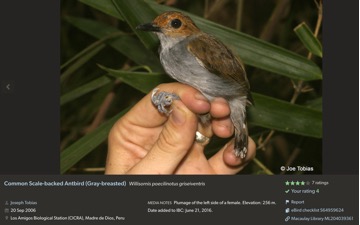
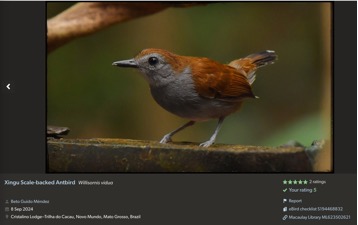
Left:
female lepidonota by Matthew Bruce. Right nominate poecilinotus
by Hugo Foxonet
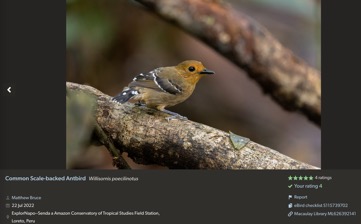
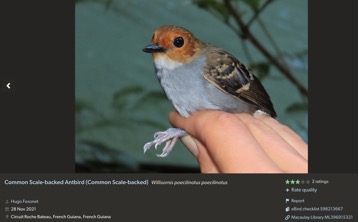
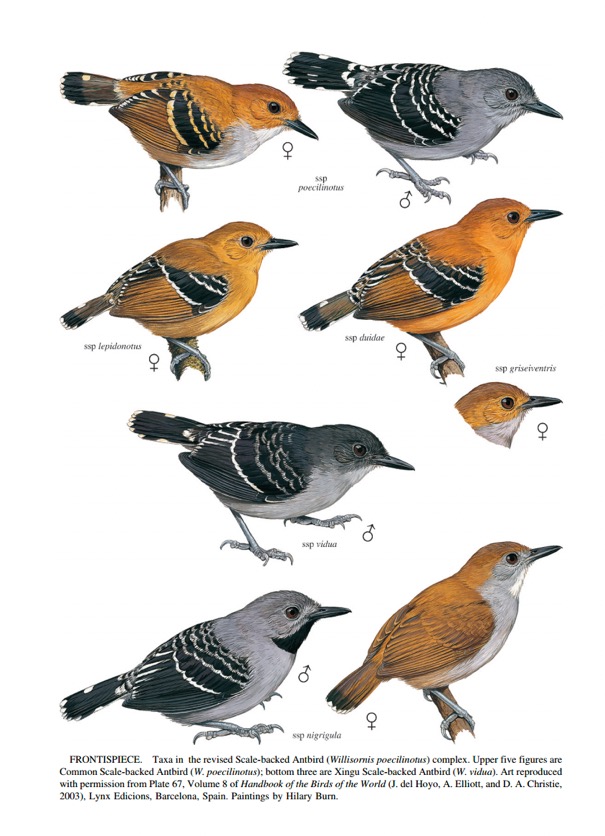
Here is
Hilary Burn’s plate as reproduced in Isler and Whitney (2011):
VOCALIZATIONS
Isler
and Whitney (2011) showed that vidua was the outlier in terms of voice,
and that was the rationale for its treatment as a separate species, and that
variation among all the other taxa was minimal.
See SACC 495 for full
details – no need to repeat here.
TAXONOMY
Quaresma
et al.’s proposed new taxonomy is as follows, with 5 monotypic species and 1
polytypic species:
Willisornis poecilinotus
(Cabanis, 1847) – Guianan shield region
Willisornis gutturalis
(Snethlage, 1914) – limited area in n. Peru and w. Brazil – see map above
Willisornis vidua
(Hellmayr, 1905) – southeastern Amazonia east of the Xingu
Willisornis nigrigula
(Snethlage, 1914) – southern Amazonia – see map above
Willisornis
griseiventris
(van Pelzeln, 1869) – southwestern Amazonia – see map above
Willisornis
lepidonota (Sclater
& Salvin, 1880 – western Amazonia – see map above
W. l.
lepidonota
W. l. duidae
Discussion
and recommendation: Quaresma et al.’s paper is excellent, with a massive
amount of data and many analyses. This
is a very complex system with 13 distinct lineages and 7 named taxa, with
varying amounts of gene flow between some of them. Plumage differences among the seven taxa range
from dramatic (within an antbird context) to subtle. This is another Amazonian “pie” (as in Cercomacra
cinerea - -see my general comments in SACC 1085) that is
difficult to force into Linnaean nomenclature.
I can state at the outset that there is no single taxonomic solution
that I can see that will not be disputed.
It’s complicated even trying to devise a voting scheme that will produce
a logical outcome. I apologize in advance to the authors if I have misconstrued
anything or botched their interpretations.
In
trying to sort all this out, here are the key points in my view. The material in quotes is from Quaresma et
al. unless indicated otherwise. Please
feel free to add, subtract, and correct:
•
Isler and Whitney established that vidua should be treated as a species
based on the Isler-Whitney framework of antbird vocal differences and species
limits. Also, subjectively, the female
plumage is the most distinctive of the lot, in my opinion.
•
The issue of paraphyly of our current polytypic W. poecilinotus is
unresolved in my opinion because the paraphyly is probably due primarily to
mitochondrial gene trees, although I am uncertain of this without seeing
separate trees for nDNA alone. Also,
Harvey et al.’s much more comprehensive genetic sampling shows that among the
taxa that they sampled, poecilinotus was indeed monophyletic. To this, Quaresma et al.’ response was “even though [Harvey et al.] was based on the
largest molecular dataset available for Willisornis and several other suboscine
lineages, it lacked samples of the genetically divergent W. p. duidae, W.
p. gutturalis, W. p. lepidonota and W. v. nigrigula, and,
therefore, a sparser taxon sampling could have influenced the recovered
topologies.”
But unless I’ve botched the localities, duidae was sampled by Harvey et
al. (Jaú, Amazonas), and whether inclusion of the missing taxa would affect the
internal topology I leave to the tree-builders.
•
poecilinotus and duidae have two contact zones, but there is no
evidence for widespread intergradation and only a couple of putative hybrids.
If indeed there is no hybrid zone despite putative direct contact, then these
two have to be treated as separate species.
•
gutturalis and griseiventris meet somewhere along the R. Juruá, “where at least some limited hybridization occurs
(Fig. 5; Supporting Information, Fig. S4).”
•
vidua vs. nigrigula: “Our
data did not support the existence of a contact zone between W. vidua
and W. nigrigula in the upper Xingu River (Fig. 1; Supporting
Information, Fig. S1), so it remains speculative whether these taxa meet in the
sector of the Xingu–Tocantins interfluve (Isler & Whitney, 2011)”.
•
There might be an unsampled contact zone between vidua and griseiventris
in the upper Xingu.
•
nigrigula vs. griseiventris: “Both of these populations are in direct contact with W.
griseiventris in the middle sector of the Tapajós–Madeira interfluve and
the upper reaches of the Tapajós and Xingu rivers, where they hybridize
(Supporting Information, Fig. S5), although selection against highly
introgressed hybrids indicates the existence of post-mating reproductive
barriers between them, causing their hybrid zone to be extremely narrow, at
least in upper Tapajós drainage (Pulido-Santacruz et al., 2018).”
•
on a personal note, I continue to object to the use of “reciprocal monophyly”
as an absolute term. It’s
contextual. It depends on the number of
individuals sampled and how close they are geographically to known or potential
contact zones. Any statement about two populations being reciprocally
monophyletic is one just one additional sample from being falsified.
•
The work of Quaresma et al. strengthens the statement made by Isler and Whitney
15 years ago, namely: “Six pairs of subspecies are apparently parapatric and
lack a known barrier to intergradation in at least a portion of their contact
zone; yet confirmed hybrids are known only for one pair in one location.” See Isler and Whitney (2011) for their
analysis of each contact zone.
So,
what is the classification that best reflects all this? Despite the lack of strong vocal differences,
to me the absence of any hybrid swarms is any of the contact zones indicates
that there is no “free interbreeding” between any of the proposed species-level
taxa in Quaresma et al. As with Cercomacra
cinerascens and the Rhegmatorhina berlepschi-hoffmannsi case, something
besides voice seems to be acting as an isolating mechanism. Personally, I regard parapatry without
evidence of free gene flow to be better evidence for species rank than any
other criterion. The most detailed
sampling of any of the contact zones (vidua vs. griseiventris;
Pulido-Santacruz et al. 2018) suggests strong post-zygotic isolation between
the two despite no evidence for voice being an isolating mechanism. Although one can’t extrapolate cleanly from
that case to the other contact zones because this is the only one in which
there are vocal differences, the phenotypic signal from all the other contact
zones is similar, i.e. no hybrid swarm.
Some of that might be an artifact of limited sampling, but we have to go
on what we know at the moment. So, and it wasn’t until after I had assembled
all this work that I had reached this conclusion, I recommend that we follow
Quaresma et al.’s six species classification until additional data say
otherwise. Congrats to the Aleixo Lab
for producing such a volume of critical data.
As
for voting, let’s try this scheme. Vote
YES/NO on each one – you only get one YES!
Option A. Treat all taxa as subspecies
of one big polytypic species, thus retreating to the classification used by
Meyer de Schauensee (1970) and others.
This would eliminate the apparent problem of paraphyly.
Option B. Maintain status quo, i.e. two
species, with vidua retained as a separate species because the vocal
data and the most detailed sampling of the contact zone indicate that at least
two species are involved, but wait for additional, more detailed sampling of
the other contact zones.
Option C. Adopt the six species
classification of Quaresma et al. as the best classification given current
available information, while acknowledging that additional data from the
contact zones might cause future revisions in some cases.
Option D. Some other combination. Pick and choose from the various remaining
combinations (and provide rationale).
English
names:
Obviously, there is no point in acting on this until we see if and how species
limits are changed, although retaining Scale-backed Antbird as the group name
seems a wise course.
References:
HARVEY, M. G., G. A. BRAVO, S. CLARAMUNT, A. M
CUERVO, G. E. DERRYBERRY, J. BATTILANA, G. F. SEEHOLZER, J. S. MCKAY, B. C.
O’MEARA, B. G. FAIRCLOTH, S. V. EDWARDS, J. PÉREZ-EMÁN, R. G. MOYLE, F. H.
SHEDLON, A. ALEIXO, B. T. SMITH, R. T. CHESSER, L. F. SILVEIRA, J. CRACRAFT, R.
T. BRUMFIELD, AND E. P. DERRYBERRY.
2020. The evolution of a tropical
biodiversity hotspot. Science 370:
1343-1348.
ISLER, M. L., AND B. M. WHITNEY.
2011. Species limits in antbirds
(Thamnophilidae): the Scale-backed Antbird (Willisornis
poecilinotus) complex. Wilson J.
Ornithology 123: 1–14.
NAKA, L. N. AND R. T. BRUMFIELD.
2018. The dual role of Amazonian
rivers in the generation and maintenance of avian diversity. Science Advances 2018 (4):eaar8575.
PULIDO-SANTACRUZ, P., A. ALEIXO, AND J. T. WEIR. 2018.
Morphologically cryptic Amazonian bird species pairs exhibit strong
postzygotic reproductive isolation. Proceedings of the Royal Society B 285:
20172081.
QUARESMA, T. F., A. A.
CRONEMBERGER, R. BATISTA, AND A. ALEIXO.
2022. Diversification and species
limits in scale-backed antbirds (Willisornis: Thamnophilidae), an
Amazonian endemic lineage. Zoological J.
Linnean Society 196: 1408–1430.
SILVA, S. M. A. T. PETERSON, L. CARNEIRO, T. C. T.
BURLAMAQUI, C. C. RIBAS, T SOUSA-NEVES, L. S. MIRANDA, A. M. FERNANDES, F. M.
D'HORTA, L. E. ARAÚJO-SILVA, R. BATISTA2, C. H. M. M. BANDEIRA, S. M. DANTAS,
M. FERREIRA, D. M. MARTINS, J. OLIVEIRA, T. C. ROCHA, C H. SARDELLI, G THOM, P.
SENA RÊGO, M. P. SANTOS, F. SEQUEIRA, M. VALLINOTO, AND A. ALEIXO. 2018.
A dynamic continental moisture gradient drove Amazonian bird
diversification. Science Advances 2019
(5)eaat5752.
Van Remsen,
July 2026
________________________________________________________________________________________________________________
Vote tracking chart:
https://www.museum.lsu.edu/~Remsen/SACCPropChart1044+.htm